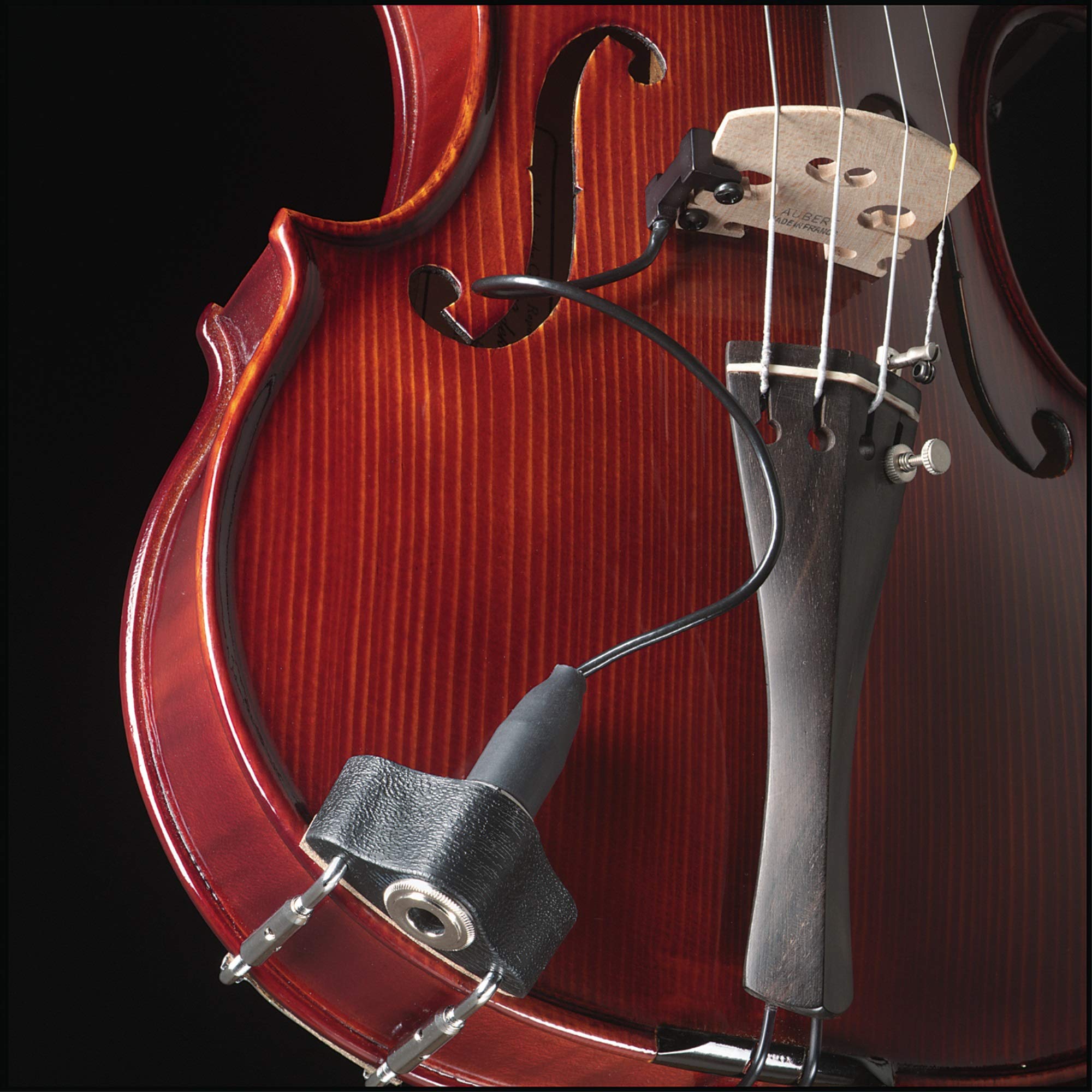
You’ve been getting by at open sessions and small gigs by leaning into your acoustic tone — maybe you’ve even avoided pickups on principle, the way a lot of classically trained players do. Then the band got louder, the room got bigger, or a sound person handed you a cable and said “plug in,” and suddenly the decision you’d been postponing became urgent. A violin pickup is a transducer — a device that converts the physical vibration of your instrument into an electrical signal you can run through a PA or amplifier. Unlike a microphone (which captures sound traveling through air), a pickup sits directly on or inside the instrument and reads the vibration at the source. That distinction matters enormously for live performance: pickups reject background noise, resist feedback, and give sound engineers something predictable to work with. This guide maps the full upgrade path from inexpensive clip-on pickups through professional undersaddle systems, names the real tradeoffs at each price point, and ends with a clear decision rule so you know exactly which tier fits your situation right now.
| EDITOR'S PICKFishman V-300 Concert Series Vi… | Mid-tierFishman V-200 Classic Series Vi… | Budget pickBarcus Berry 1320 Electric Viol… | |
|---|---|---|---|
| Mounting | — | — | Built-in bridge |
| Series | Concert | Classic | — |
| Color | — | MultiColored | — |
| Price | $229.95 | $178.54 | $109.99 |
| See on Amazon → | See on Amazon → | See on Amazon → |
The Upgrade Narrative Most Violin Players Follow
The pattern across owner reviews is consistent enough to be almost a rite of passage. Players spend years — sometimes decades — resisting pickups because they’re attached to their acoustic sound and worried about compromising it. Then a specific gig forces the issue: the room is loud, a monitor is feeding back, or mobility (moving around the stage, stepping away from the microphone stand) suddenly matters.
A reviewer of the Barcus Berry 3100 captures this almost word for word: they’d resisted pickups for years until their gig situations got too loud for a mic setup to be practical. That resistance-then-conversion arc is worth taking seriously. If you’re reading this article, you’re probably already past the resistance phase. The question is which tier of pickup actually solves your problem without creating new ones.
There’s a second underappreciated reason to consider a pickup beyond raw volume: playing development. A Fishman V-200 reviewer describes finally being able to hear themselves clearly through a monitor and, as a direct result, catching intonation problems they’d been glossing over acoustically. Getting reliable monitor volume — the kind a pickup provides in a way a mic rarely can cleanly in a loud mix — turns amplification into a practice tool as much as a performance tool. That’s not a marketing angle; it’s a practical consequence of finally hearing yourself in real time with zero latency and no bleed.
Tier One: The Clip-On ($40–$100) — Fast, Forgiving, and Finite
Clip-on pickups — sometimes called bridge-wing pickups because they clamp onto the wings of the violin bridge — are the natural entry point. They require zero permanent modification, install in seconds, and come off just as quickly.
The KNA VV-3 has become something of a benchmark in this category. What makes it stand out in aggregated owner reviews is a specific practical detail: its design allows it to stay mounted on the bridge while the instrument is in its case, without causing damage over time. For players who move between amplified and acoustic settings frequently, that “leave it on and forget it” workflow is genuinely valuable. You’re not hunting for a pouch, you’re not re-mounting the pickup under pressure backstage, and you’re not risking the finish or the bridge with repeated clip-on/clip-off cycles.
The honest tradeoffs at this tier:
- Tone is functional but rarely mistaken for acoustic. Clip-ons read bridge vibration from the outside of the wood, which means they capture less of the instrument’s full resonant character than a pickup that sits under the foot or inside the bridge.
- Output is typically lower than undersaddle systems, which means you may need a preamp (more on that below) to get enough gain for a full PA.
- In high-SPL environments — festival stages, loud bluegrass jams — the clip-on’s physical placement can make it more susceptible to mechanical noise if it shifts slightly.
That said: for players doing smaller folk sessions, house concerts, or occasional open mic spots, this tier is often more than enough. The KNA VV-3 specifically gets consistent marks for tone that sits well in a mix without requiring aggressive EQ correction.
Tier Two: The Under-Foot Pickup ($100–$200) — Committed Placement, Better Coupling
Under-foot pickups — where “foot” refers to the base of the violin bridge that makes contact with the instrument’s top — are the middle tier in both price and invasiveness. They sit between the bridge foot and the spruce top of the violin, which puts them closer to the main vibrating surface of the instrument.
The Realist Copperhead is the most-discussed pickup in this category among folk and Celtic players. Its placement gives it a warmer, more acoustic-adjacent tone than most clip-ons — reviewers consistently describe it as one of the least “electric-sounding” pickups available, which matters enormously to players who’ve built their identity around acoustic tone.
There is, however, a genuine inconvenience that one Realist Copperhead reviewer surfaces and that deserves a direct mention: removing the violin from its case requires extra steps because the pickup cable routes under the bridge foot. You can’t just lift the instrument out — you have to manage the cable and pickup placement each time. For players who open their case onstage or backstage in dim light, that’s a real friction point, not a minor footnote.
The Barcus Berry 1320 occupies similar territory. A reviewer with 35 years of professional installation experience is unambiguous about one thing: once this pickup is installed, do not move it. The piezo element inside can crack or decouple if repositioned, and the warmth players value in its tone is partly a function of the precise seating pressure it builds up over time. This is not a clip-on-style “try it for a month.” If you go this route, treat it as permanent infrastructure — which is exactly how professional gigging musicians tend to think about their rigs.
Tier Three: The Undersaddle and Replacement Bridge System ($200–$350) — The Professional Commitment
At the top of this guide’s scope sits the LR Baggs Violin Pickup, which uses a different approach: rather than adding a pickup to your existing bridge, it arrives as part of a replacement bridge system. The transducer is integrated directly into the bridge itself.
The most surprising thing owners report — and Acoustic Guitar Magazine’s coverage of undersaddle and integrated systems has noted this phenomenon in acoustic guitar contexts as well — is that a well-fitted replacement bridge can improve the instrument’s acoustic tone even before you plug in. A properly fitted bridge at the right height and with the right break angle affects string tension, resonance, and projection. Some reviewers explicitly say the LR Baggs bridge improved their unplugged sound, which is a non-trivial benefit on an instrument you’ll also play acoustically.
The Fishman V-200 is the other major name in this tier. Across owner reviews, the recurring theme is emotional: players describe the V-200 as the pickup that finally made them feel like they could perform confidently in mixed ensembles. Strings Magazine’s coverage of amplification options for acoustic violinists consistently points to Fishman as a benchmark for natural-sounding reproduction at this price point.
By the numbers — rough output and installation comparison:
| Pickup | Approx. Price | Installation Type | Preamp Needed? |
|---|---|---|---|
| KNA VV-3 | ~$70 | Clip-on, no tools | Often, yes |
| Realist Copperhead | ~$150 | Under bridge foot, reversible | Sometimes |
| Barcus Berry 1320 | ~$130 | Permanent professional install | Sometimes |
| LR Baggs (replacement bridge) | ~$250–$300 | Luthier recommended | Less often |
| Fishman V-200 | ~$130–$160 | Under bridge foot | Sometimes |
Frequently Asked Questions
Can I install a violin pickup myself, or do I need a luthier?
It depends on the pickup type. Clip-ons like the KNA VV-3 are genuinely DIY — no tools, no risk. Under-foot pickups like the Fishman V-200 or Realist Copperhead sit between the bridge foot and the top; a careful player can seat these correctly, but fit matters, and an improperly seated pickup produces thin, buzzy tone. The Barcus Berry 1320, per the professional installer review cited earlier, should be considered a permanent installation best done by a luthier — moving it after installation risks destroying the element. The LR Baggs replacement bridge system involves fitting a new bridge, which is luthier territory unless you have experience fitting bridges.
Will a clip-on pickup damage my bridge or violin finish?
The KNA VV-3 specifically is designed to avoid this — reviewers report no finish damage after extended use, and its case-storage capability suggests the clamping pressure is calibrated to be gentle. Generic clip-ons with aggressive spring tension are a different story. If you’re concerned about a fine or vintage instrument, the KNA is the safer choice in this category.
What is the difference between the Fishman V-200 and V-300 for a gigging folk player?
The V-200 is the standard under-bridge-foot transducer. The V-300 adds a preamp/EQ unit, which gives you onboard control of volume and tone shaping before the signal hits your amp or DI box. For a folk player going direct into a PA with a sound engineer who will EQ from the board, the V-200 is often sufficient. For a player who self-mixes, plays through a personal amp without a dedicated sound person, or needs to cut feedback in a monitor, the V-300’s onboard control is worth the price step. Violinist.com community discussions on this comparison consistently land in the same place: the V-300 is for players who need to be self-sufficient; the V-200 is for players who have technical support.
Why does the Realist Copperhead make it harder to remove the violin from its case?
The Copperhead pickup sits under the bass-side bridge foot, with a thin cable routing away from the bridge. Because it’s physically between the bridge and the top of the instrument, removing the violin from a standard case requires lifting carefully so the bridge foot doesn’t catch, and managing the cable routing each time. It’s not a dealbreaker, but players who open and close their cases frequently — especially in low-light backstage conditions — should factor this in. Some players solve it by leaving the cable attached to the instrument at all times; others find a case with more clearance.
Do I need a preamp with the Fishman or KNA pickups?
Both pickups produce what’s called a high-impedance piezo signal, which sounds thin and brittle if fed directly into a standard instrument cable and then into a mixing board’s line input. A preamp — either a dedicated buffer/preamp pedal or a DI box with high-impedance input — corrects the impedance mismatch and gives you a full, warm output. Sound On Sound’s coverage of acoustic instrument amplification is explicit about this: piezo pickups nearly always benefit from a proper impedance buffer in the signal chain. Budget solutions start around $30–$50 for a simple buffer pedal; the Fishman V-300 bundles this function into the pickup itself.
Will any of these pickups work with an old German or vintage instrument?
Generally, yes — with caveats. Clip-ons like the KNA VV-3 work on any violin with a standard bridge, including old German trade instruments. Under-foot pickups require a bridge that is properly fitted and sitting flat; older instruments sometimes have warped or improperly fitted bridges that would need attention first. The LR Baggs replacement bridge system involves replacing the bridge entirely, which on a vintage instrument should be discussed with a luthier — a new bridge affects the instrument’s character and setup, and some owners of fine older instruments prefer not to alter bridge geometry.
The Decision Rule
Here’s the framework that emerges from working through all the tiers:
If you play 1–3 times per month in small rooms and need a zero-commitment trial: start with the KNA VV-3. It’s the lowest-friction entry point with the best-documented case-safety, and it won’t lock you into anything.
If you gig regularly in folk or Celtic contexts and acoustic tone fidelity is non-negotiable: the Realist Copperhead is the most-recommended pickup in that community for a reason, but budget for the case-access inconvenience and consider whether you need a preamp.
If you’re ready to treat this as permanent infrastructure on a working instrument: the Barcus Berry 1320 (with professional installation and the understanding that it does not move) or the LR Baggs replacement bridge system will give you the most reliable, stage-ready output. The LR Baggs has the added upside of potentially improving your acoustic tone, which is reason enough to have a luthier conversation.
If budget is the binding constraint right now: the Fishman V-200 at its price point offers a meaningful step up from clip-ons with a tone character that owners describe as genuinely satisfying — and that monitor-volume clarity that helps your playing develop is a real return on the investment.
Your next step: if you’re within the KNA or Fishman tier, look closely at what preamp or DI solution you’ll pair with the pickup — that decision is at least as important as the pickup itself, and it’s where a lot of players leave performance on the table.