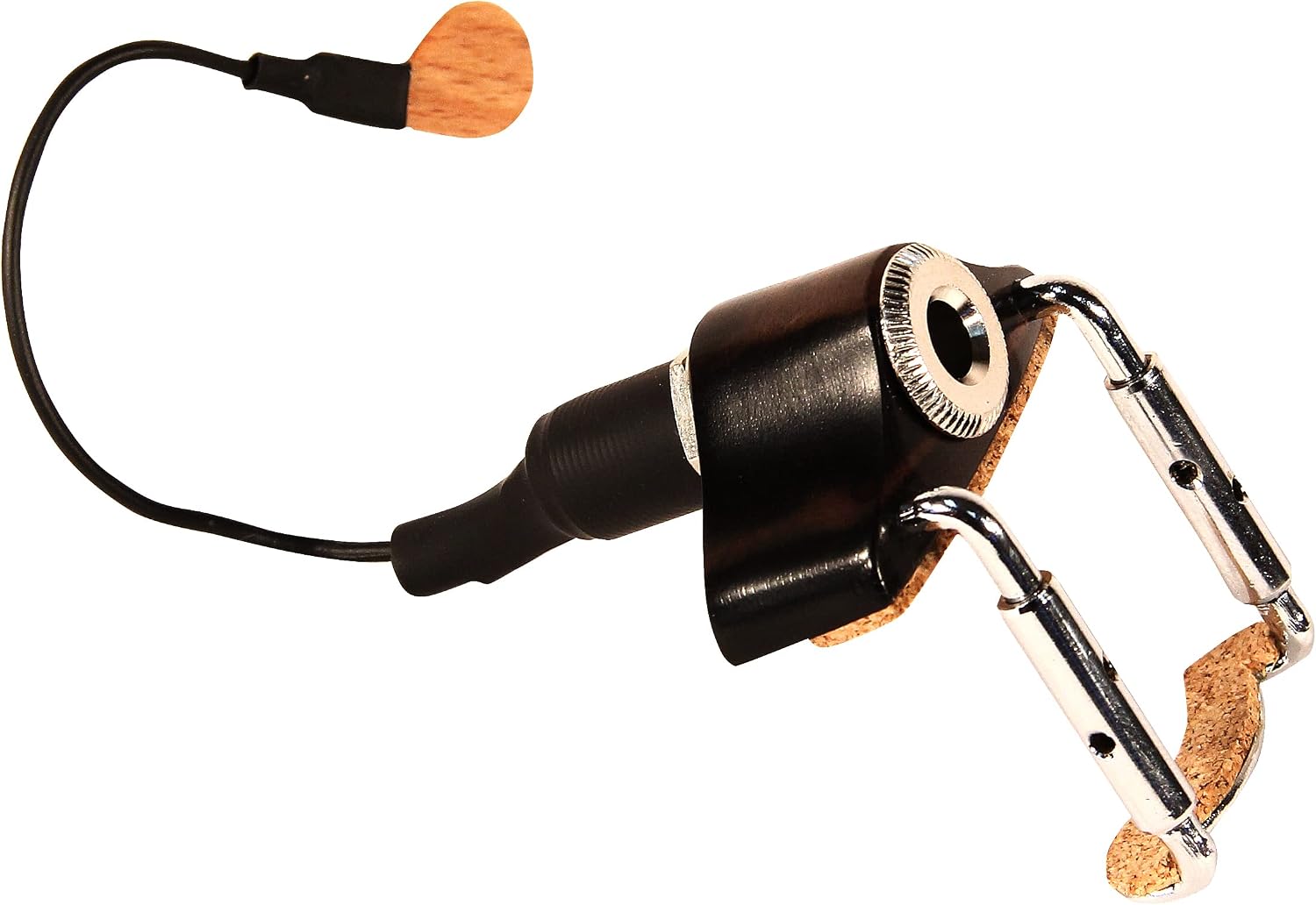
You’ve just landed a Friday night gig — a Celtic session that’s moving from the pub’s back room into the main hall, where a house PA (the speakers and amplifier system the venue uses to push sound to the whole room) will be running. Your acoustic violin sounds beautiful in a quiet room, but the moment a bodhran and a loud bouzouki get going, you’re fighting for volume. Someone suggests you “just get a pickup” — meaning a small sensor that attaches to your violin, captures its vibration, and sends that signal through a cable to a speaker or mixing board. Simple enough in theory. In practice, violin pickups range from a $50 clip you can attach in thirty seconds to a $300 custom-fit transducer (a contact sensor that reads mechanical vibration rather than air movement) that requires a luthier to install. Choosing the wrong tier means either wasting money or showing up under-equipped. This guide maps four real product tiers to the specific situations where each one justifies its price — with the tradeoffs named explicitly, so you can make the call before the gig.
The Four Tiers at a Glance
Before diving into products, here’s how the market stacks up in mid-2026:
| Tier | Price Range | Install | Best For |
|---|---|---|---|
| 1 — Bridge Clip | $50–$80 | Self, 30 sec | Practice, low-volume sessions |
| 2 — Clamp Transducer | $80–$130 | Self, 5 min | Casual gigging, folk jams |
| 3 — Bridge-Wing Fit | $150–$220 | Self or luthier | Regular stage use |
| 4 — Undersaddle/Bridge Replace | $250–$350+ | Luthier required | Professional touring, worship |
The jump between tiers isn’t just price — it’s a change in installation permanence, tonal fidelity, and feedback resistance. Each step up buys you something specific. The question is whether your current situation actually needs it.
Tier 1 and 2: The Clip and Clamp Options (KNA VV-3 and Barcus Berry 3100)
Where these live: The $50–$130 range is dominated by piezo transducers that clamp onto or clip to the violin bridge — the small wooden bridge that holds the strings above the body. No drilling, no glue, no luthier visit.
The KNA VV-3 is one of the most consistently discussed pickups in this tier across owner forums and review threads. The practical advantage owners highlight most: the pickup stays on the bridge even when the instrument is in its case, which matters more than it sounds. If you’re moving between a rehearsal space and a venue, you’re not fiddling with re-mounting under pressure. Owner reports on placement offer a genuinely useful finding — positioning the element on the A/E side of the bridge (treble side) versus the D/G side (bass side) produces meaningfully better projection on the upper strings, particularly for fiddle styles where high-note clarity cuts through a mix. For Celtic and bluegrass players where the high register carries the melody, this is worth experimenting with before your first gig.
The KNA VV-3V is the same pickup with a volume control built into the cable — useful if you’re running directly into a PA channel without a preamp. If you’re running through a DI box (a device that converts your pickup’s signal to work with professional sound systems) or a dedicated preamp, the standard VV-3 is fine and slightly cleaner in the signal chain.
The tradeoff you need to name before buying: Clip-on piezos amplify bridge vibration, which means any sympathetic rattle, string buzz, or case-impact noise can read as signal. In a low-volume session or a small venue with a careful FOH engineer, that’s manageable. On a loud stage with wedge monitors (the floor-facing speakers that let you hear yourself), feedback becomes a serious issue. Sweetwater’s violin pickup education content explicitly notes that bridge-clip designs have the highest susceptibility to feedback at volume, because the pickup is physically exposed to the air rather than isolated inside the instrument.
The Barcus Berry 3100 sits at the upper edge of Tier 2 and addresses some of this. Owners who use it weekly in stage settings report it as reliable — but the installation detail that trips up first-timers is critical: the lower nut on the 3100 must seat inside the bridge’s lowest gap, not rest against the outside of the bridge foot. If you don’t get that fit right, you’ll get uneven contact and a thin, unbalanced tone. The Acoustic Guitar Magazine installation workshop column notes this kind of contact-fit issue is the most common cause of dissatisfaction with bridge-clamp transducers — and it’s entirely solvable with fifteen minutes of careful re-seating.
Decision rule: If your gigs are informal — sessions, small stages, practice with a band — and you’re not yet sure you’ll need amplification consistently, start here. If you already know you’re gigging regularly, Tier 2 is a ceiling, not a destination.
Tier 3: The Bridge-Wing Fit (Fishman V-200 and Headway The Band)
This is where the tradeoffs get more interesting — and where the decision requires more information about your specific instrument.
The Fishman V-200 uses an undersaddle-style element that fits into a routed slot in the violin bridge. The recurring note in owner reviews is that many factory violin bridges don’t have a slot wide enough to accept the V-200’s element without widening. Reviewers universally describe this as a minor, resolvable issue — but it does mean a luthier visit for most players. Acoustic Guitar Magazine’s bridge transducer guide estimates a bridge slot-widening job runs $30–$60 at most shops. Factor that into the true cost. In exchange, you get a pickup that is physically isolated from the air, dramatically reducing feedback susceptibility, and a tone that Strings Magazine’s amplification feature describes as significantly more “neutral” than clip-on designs — meaning the pickup colors the sound less, letting the violin’s natural character come through.
The Headway The Band is the outlier in this tier and worth examining carefully. It uses an internal microphone combined with a contact element — a hybrid approach that, in ideal conditions, gets closer to condenser microphone sound than any pure piezo can. One owner conducted an A/B test against a condenser mic at 1.5 feet and gave The Band a 5-star rating for fidelity in that comparison. That’s a real result worth noting.
But the durability pattern in the review aggregate is a genuine concern: both a 1-star and a 3-star review from verified purchasers cite glue failure and feedback sensitivity as recurring problems. Sound On Sound’s miking vs. piezo technique guide explains why: internal microphone elements, even in hybrid designs, are inherently more feedback-prone in loud environments because they capture air movement rather than isolating vibration. If your gig is a low-volume acoustic stage or a recording session, The Band is a compelling choice. If you’re playing in a loud worship band or a festival environment with substantial stage volume, that feedback sensitivity is a real liability.
Decision rule: If your bridge slot can accept the V-200’s element with minimal luthier work, and you play in medium-volume stage environments, the Fishman is the cleaner, more reliable choice. If you’re primarily in controlled acoustic settings — recording, folk concerts, intimate stages — The Band’s tonal fidelity advantage is worth the trade.
Tier 4: The Undersaddle Replacement (LR Baggs Violin System)
The LR Baggs is the professional touring answer, and it asks for a real commitment: the existing bridge is replaced with a custom-fitted bridge containing an integrated transducer. This is a luthier job, period. The installation cost varies by shop, but budget $80–$150 in labor on top of the system cost, putting the all-in number at $350–$500 for most players.
The finding that consistently surprises owners: the acoustic unplugged sound of the violin frequently improves after the bridge replacement. One owner specifically attributes this to the geometry of the new bridge — a well-fitted replacement bridge made from quality maple can improve string-to-body energy transfer even without the electronics active. Strings Magazine’s amplification feature notes that this is an underreported benefit of professional transducer bridge installations: the instrument often sounds better acoustically and amplified.
What you’re buying at this tier is isolation, output consistency, and feedback rejection. The element is fully enclosed in the bridge, mechanically isolated from air, and the output signal is strong and even across all four strings. For a professional session player whose violin goes into the same PA every night, or a worship musician running in-ears and dealing with loud stage environments, this is the tier that removes variables. Sweetwater’s product education content consistently places the LR Baggs in the “professional installation” category precisely because of this consistency — it’s not the most exciting pickup story, but it’s the one that doesn’t fail on a Thursday night before a Friday festival.
Decision rule: If your violin is a primary income-generating instrument and you’re on stage more than twice a month in amplified settings, the math favors Tier 4. The luthier cost is a one-time investment; the reduction in night-of troubleshooting is ongoing.
Frequently Asked Questions
Can I install a violin pickup myself, or do I need a luthier? Tiers 1 and 2 — clip and clamp designs like the KNA VV-3 and Barcus Berry 3100 — are genuinely self-install. Tier 3 depends on your bridge: if it already has an appropriate slot, the Fishman V-200 element drops in without professional help. If the slot needs widening, that’s a luthier job. Tier 4 (LR Baggs bridge replacement) always requires a luthier. Don’t attempt a bridge replacement as a first install — a poorly fitted bridge can damage string angle and playability.
Will a bridge-mounted pickup mute or dampen my acoustic violin’s natural sound? Clip-on designs add minor mass to the bridge, which some players detect as a subtle change in unplugged resonance. Owner reports on the KNA VV-3 are mixed — most say no detectable difference, a few report slight reduction in sustain. Undersaddle systems like the LR Baggs, counterintuitively, often improve unplugged tone because the replacement bridge is professionally fitted, as noted above.
What is the difference between the KNA VV-3 and VV-3V models? The VV-3V adds an inline volume control on the cable. If you’re running directly into a PA or a simple amp without a preamp or DI box, the volume control is practical. If you’re running through a preamp with its own gain control, the standard VV-3 is cleaner.
Does a piezo pickup sound harsh or “electric” compared to a microphone? Purely compared to a studio condenser mic, yes — piezo designs have a different frequency character, sometimes described as harder in the high midrange. The Sound On Sound miking vs. piezo guide notes that quality piezos in well-fitted installations close this gap significantly, and most PA engineers can EQ the harshness out of a good undersaddle signal. At Tier 4, the difference is minimal in a live context. For recording, the gap remains meaningful — and that’s where hybrid designs like The Band have genuine value.
How do I reduce feedback when using a violin pickup in a loud band or worship setting? Three levers: pickup isolation (undersaddle designs feedback less than clip-ons), preamp EQ (notching out the feedback frequency, typically 300–800Hz on violin), and monitor placement (keeping stage wedges aimed away from the instrument). At high stage volumes, Tier 4 with a dedicated preamp is the only configuration that gives you all three levers simultaneously.
Your Next Move
Map your current situation to the tier decision:
- Playing fewer than 2 amplified gigs per month, low stage volume → Start with the KNA VV-3, experiment with A/E-side placement, and see how far it takes you before investing more.
- Regular gigging, medium stage volume, controlled environments → The Fishman V-200 with a luthier slot-widening is the cleaner Tier 3 commitment.
- Professional touring, worship, or income-dependent stage work → The LR Baggs bridge replacement removes variables. Book the luthier appointment the same week you order.
If you’re not yet sure which category you’re in, spend thirty minutes reading the verified owner reviews on each product before your next purchase decision — the patterns in what players praise and what they flag are consistent enough to be a reliable signal.