
You’ve just started violin lessons — or maybe you’re a few months in — and suddenly the internet is full of people selling you things. Fingerboard stickers (thin adhesive strips or dots that mark where your fingers should land on the violin’s fingerboard, the long wooden strip your fingers press against), rubber practice mutes (small rubber or metal gadgets that clamp onto the bridge — the small wooden piece that holds the strings up — to soften the sound), and rosin (the sticky amber-colored cake you rub onto your bow hair to create friction against the strings, without which almost no sound comes out at all). None of these items costs much. But make the wrong choice, or use them wrong, and you’ll either slow your progress, annoy your neighbors anyway, or end up with a bow that skates uselessly across the strings. This guide breaks down what each accessory actually does, what real owners and teachers report about the most popular budget options, and — critically — when to stop using the training wheels so they don’t become a crutch.
Fingerboard Stickers: A Training Tool, Not a Shortcut
The violin has no frets. That’s a feature, not a bug — it’s what gives the instrument its singing, slides-between-pitches expressiveness — but for beginners, it also means there’s nothing stopping you from planting your finger slightly off and playing a note that’s technically a violation of the Geneva Conventions. Fingerboard stickers are position guides: adhesive markers placed at the first, second, and third finger positions to give your eyes and muscle memory a reference point while your ear catches up.
The debate about whether adults should use them is real but somewhat overblown. Community discussion on Violinist.com — in forum threads specifically addressing fingerboard position guides and beginner accessories — shows opinion dividing along predictable lines: traditionalist teachers tend to resist them, while pragmatic instructors who want students to stay students — rather than quit out of frustration — often permit them for the first few months. The honest answer is that they’re a legitimate tool when used deliberately and removed on a schedule.
Among the products in this space, the Fantastic Finger Guide has earned an unusual level of credibility. In a market segment where most reviews are two lines from a first-week player, a self-described luthier who tested multiple position-guide products across professional and personal use called this one “the winner in my personal and professional opinion” — expert validation that’s genuinely rare in budget accessory reviews. Reviewers do consistently note slight alignment variance from instrument to instrument, but the pattern across reviews attributes this to natural variation between individual violins, not a product defect. If the markers land a hair off on your instrument, a fraction of a millimeter of adjustment is normal.
8
In stock on Amazon
Check price on AmazonThe key decision frame here: Are you using the stickers to build a reference point your ear can eventually replace, or are you using them as a permanent crutch to avoid developing pitch recognition? The former is smart practice strategy. The latter will plateau you. Strings Magazine’s beginner setup resources — specifically the publication’s “Beginner Setup Essentials” overview in its online resource library — consistently advise treating position guides as scaffolding: you build the wall, then take the scaffolding down.
Rubber Practice Mutes: Know What You’re Actually Buying
Here’s where expectation management matters most, and where the reviews tell a genuinely useful story.
A practice mute — specifically a rubber mute that clamps over the bridge — does reduce volume. It does not make the violin silent. Across aggregated reviews of the eBoot rubber practice mute, a persistent and important pattern emerges: buyers hoping for apartment-safe silence report roughly half the volume reduction they expected. One reviewer stated explicitly that it was “still louder than expected.” Another described the reduction as “about half.” If your neighbors are light sleepers and you’re planning a midnight practice session, a rubber bridge mute is not your solution — you need a dedicated silent electric violin for that use case. Sweetwater’s editorial content, in its Electric Violin Buyer’s Guide, addresses this distinction directly: piezo-pickup silent electric instruments are purpose-built for genuine quiet practice in a way that acoustic mutes simply are not.
What a rubber mute is good for: taking the edge off the instrument during daytime practice in a normal apartment or house, reducing the shrillness of a student instrument that tends to run bright, and softening the sound enough that you can practice without it carrying two rooms away. That’s a genuine and useful function — it’s just not silence.
A few other owner-reported notes worth knowing before you buy:
- Multiple reviewers mention a rubbery smell when the eBoot mute arrives. Universally, owners describe this as temporary and say it dissipates within a few days.
- The eBoot rubber practice mute is also purchased by violin teachers as a classroom supply for students — a professional-use pattern that signals confidence in basic reliability at scale. Note that when shopping for a multi-piece set, look for listings described as a four-piece rubber mute set rather than searching by product code, since bare product identifier strings are an unhelpful way to shop for teaching supplies.
8
In stock on Amazon
Check price on AmazonThe decision rule: If you need to reduce volume for daytime consideration-of-others practice, a rubber mute earns its low price point. If you need true quiet practice, you’re shopping for a silent electric instrument, not a mute.
By the Numbers: Mute Reality Check
| Expectation | Reality Per Owner Reports |
|---|---|
| Volume reduction | ~50%, not silence |
| Smell on arrival | Present; resolves in days |
| Bridge fit | Universally fits standard 4/4 bridge |
| Bulk teacher purchase | Yes — teachers buy multi-piece sets for classroom use |
Rosin: The Lowest-Stakes Decision in Your Kit
Good news: rosin is the place where you can stop overthinking. The Strad, in its “Rosin Demystified: What Every Player Needs to Know” feature in its online edition, notes that while advanced players and professionals develop genuine preferences for specific rosins based on climate, bow hair type, and playing style, beginners are simply trying to achieve adequate friction between bow and string. Almost any decent rosin accomplishes this.
The Fangjoy rosin (sometimes spelled Fansjoy in listings) is a case study in this principle. Reviews are brief and positive. There are no substantive complaints to report — not because reviewers are withholding, but because rosin at this price point and for this use case simply doesn’t generate much controversy. It works. You apply it to the bow hair by drawing the bow back and forth across the cake several times, and then the bow grips the string.
8
In stock on Amazon
Check price on AmazonWhere rosin does become a real variable — and this is relevant context for ElectricFiddles.com readers thinking ahead — is on electric violins with piezo pickups. Some rosins produce more rosin dust than others, and that dust can accumulate in the body cavities of acoustic-electric instruments or settle on pickup surfaces. Strings Magazine has addressed this in its coverage of electric violin maintenance, noting that players amplifying through piezo systems should prefer lower-dust formulas. But for a beginner on an acoustic student instrument in year one? Buy rosin, apply rosin, don’t overthink rosin.
Replacement Strings: The Unlabeled Landmine
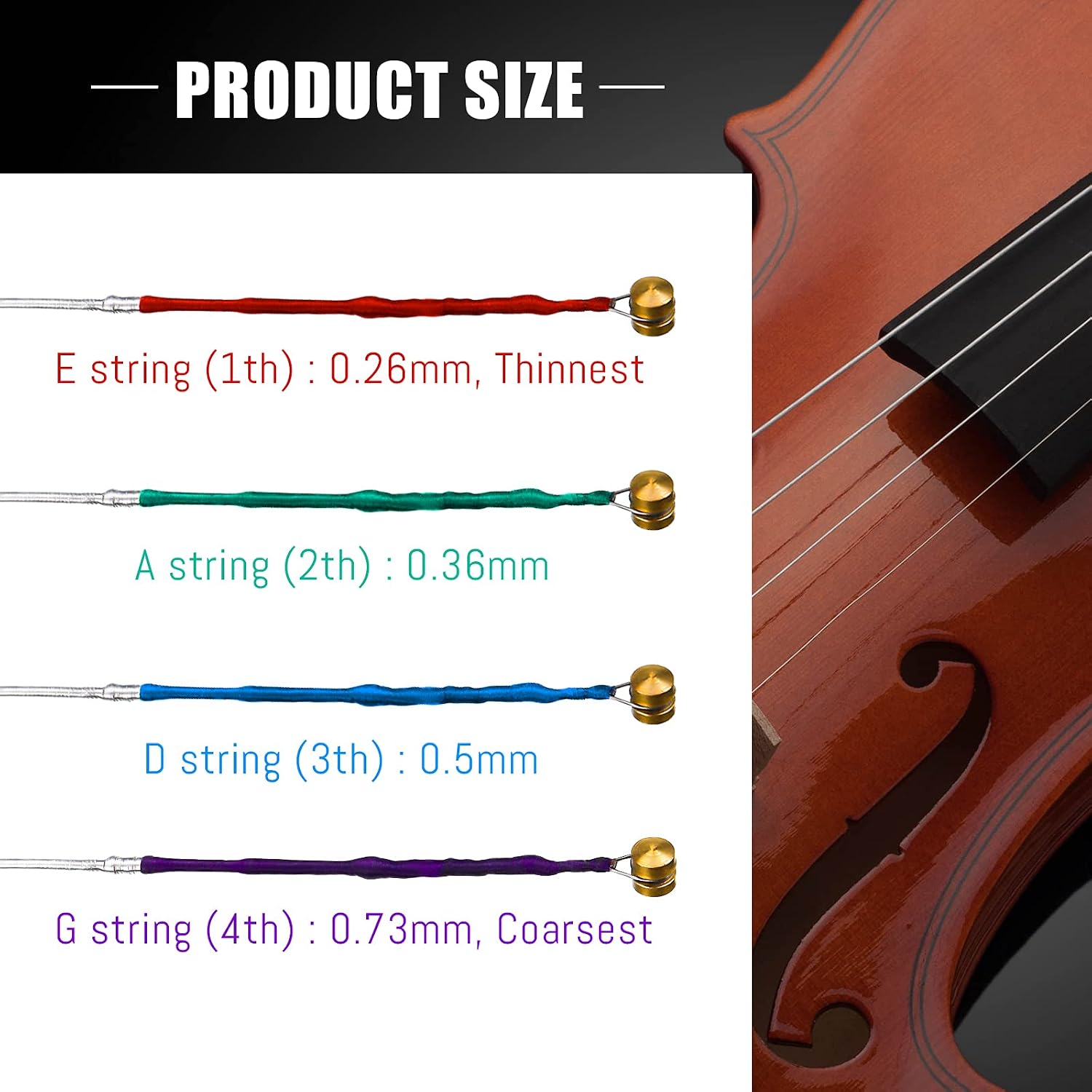
One accessory category that often catches first-year players off guard: replacement strings. Strings break, or they go false (lose their ability to hold correct pitch), and suddenly you need to know which string is which. On a violin, the four strings are tuned G-D-A-E from lowest to highest, and most quality string sets use color-coded tailpiece loops or ball ends so you can identify them.
Cheap steel string sets — the kind that come in budget multipacks — frequently skip this entirely. Per one reviewer’s account, they sorted an unlabeled set by micrometer measurement — physically measuring the diameter of each string — to figure out which was which. This is, to put it charitably, an advanced solution to a problem that shouldn’t exist.
If you buy a replacement set and find no color coding and no labeling, here’s the practical workaround: the strings are different gauges, meaning different physical thicknesses. The G string (lowest pitch) is the thickest. The E string (highest pitch) is the thinnest — often a plain steel string rather than wound wire. You can feel the difference with your fingers, or use a ruler to compare. Violinist.com’s community forum has documented this workaround repeatedly for budget string sets — search the site’s beginner accessory threads for detailed measurement comparisons posted by experienced players. It’s annoying, but it’s solvable.
Frequently Asked Questions
Should I use fingerboard stickers as an adult beginner or is it considered cheating?
It’s not cheating — it’s scaffolding. Adult learners often have stronger analytical brains but less neuroplastic muscle memory than children, which means position guides can help bridge the gap while your ear develops. Use them intentionally, with a plan to remove them. Community consensus documented in Violinist.com’s forum discussions leans toward “use whatever keeps you playing,” and a student who stays in lessons is better than a student who quit.
How much does a rubber practice mute actually reduce violin volume — will my neighbors still hear me?
Expect roughly half the volume reduction, not silence. Owners consistently report that a rubber bridge mute takes the edge off but doesn’t eliminate sound. In a normal house during daytime hours, you’ll likely be fine. In a thin-walled apartment at 10pm, your neighbors will still hear you. For genuine quiet practice, Sweetwater’s Electric Violin Buyer’s Guide identifies silent electric violins — instruments with piezo pickups and no acoustic resonance chamber — as the real solution for players who need near-silence.
When should I take fingerboard stickers off my violin?
Most teachers recommend beginning to remove them around the three-to-six month mark, or whenever your ear can reliably catch a misplaced note before you hear it confirmed. Remove one at a time rather than all at once — start by pulling the third-finger marker, which is typically the most advanced position, and work backward. Strings Magazine’s beginner guidance, covered in its “Beginner Setup Essentials” resource, suggests treating removal as a milestone, not a loss.
How do I tell which string is which if my replacement set has no color coding?
Feel the gauge (thickness). G is thickest, then D, then A, then E (which is often plain steel and noticeably thinner than the wound strings). If you have a ruler or digital calipers, measure the diameter — G strings on a standard 4/4 violin run around 0.68–0.72mm wound diameter, while E strings are typically 0.26mm plain steel. It’s an annoying workaround for a problem that labeled strings solve instantly.
Is cheap rosin fine for a beginner or does it matter what brand I use?
For a beginner, cheap rosin is genuinely fine. The Strad’s “Rosin Demystified” feature acknowledges that rosin preference is a nuanced topic for advanced players — climate, bow hair, and instrument all factor in — but the baseline requirement is simply adequate friction, which entry-level rosins provide. Buy it, use it, and revisit the question in a few years when you’re developing more refined bow technique.
Your Clear Next Step
If you’re stocking your first-year accessory kit, here’s the decision rule in plain terms: start with rosin (non-negotiable, buy it first), add a fingerboard position guide if your teacher permits or if you’re self-teaching (the Fantastic Finger Guide has the professional endorsement to back it up), and buy a rubber mute only if you’ve made peace with half-volume reduction rather than silence. Skip unlabeled string sets when you can — the hassle of sorting by gauge is a real cost on a day when a string breaks mid-practice.
Once your ear develops and the stickers come off, you’ll be making decisions about your instrument itself — and that’s where the deeper investment questions begin. Read our guide to electric violin pickup systems when you’re ready to think about amplification.