
A shoulder rest is exactly what it sounds like: a curved bracket that clips onto the bottom edge of your violin and bridges the gap between the instrument and your shoulder, so you don’t have to grip the violin with your chin or tilt your head at an awkward angle to hold it. Sounds simple. But here’s the part no one warns beginners about — the gap between your shoulder and your jaw is different from everyone else’s. If you’re long-necked, short-necked, sloped-shouldered, or broad-shouldered, the “standard” rest that came with your instrument almost certainly doesn’t suit your anatomy. The result isn’t just discomfort; it’s inconsistent bow angle, scroll drift mid-phrase, and over time, the kind of tension injuries that sideline players for months. This guide compares four of the most-discussed shoulder rests across intermediate and advancing player communities — Bonmusica, Kun, Everest, and Fiddlerman — with a clear decision framework so you can stop guessing and start playing with a setup that actually works.
| EDITOR'S PICKKun Collapsible Shoulder Rest -… | Mid-tierFiddlerman Wood Violin Shoulder… | Budget pickKun Original - 4/4 Violin Shoul… | |
|---|---|---|---|
| Fits sizes | 4/4 | 4/4 & 3/4 | 4/4 & 3/4 |
| Collapsible | ✓ | ✓ | — |
| Adjustable feet | — | ✓ | — |
| Material | — | Wood | — |
| Price | $28.75 | $22.89 | |
| See on Amazon → | See on Amazon → | See on Amazon → |
Why Shoulder Rest Fit Is a Body Geometry Problem, Not a Quality Problem
The most important insight buried in player discussions and editorial guidance is this: most players don’t upgrade shoulder rests because their old one broke. They upgrade because it never really fit. Strings Magazine, in their buyer guidance feature “Choosing the Right Shoulder Rest,” notes that rest selection should begin with a player’s neck length, shoulder slope, and collarbone prominence — not brand loyalty or price point. That’s the lens worth applying here.
The upgrade ladder that emerges from reviewing player feedback on violinist.com and in Sweetwater’s shoulder rest buyer commentary follows a recognizable pattern:
- Starter rest (whatever shipped with the instrument) → fails because it’s too shallow or too rigid
- Kun → works for many players; still leaves some with pivot or height problems
- Bonmusica → solves the pivot problem for players with specific collarbone geometry
- Everest or Fiddlerman → addresses edge cases Kun and Bonmusica don’t cover
The tradeoff framework isn’t “which is best” — it’s “which fits the body you’re playing in tonight.”
The Four Rests: What Each One Actually Does Differently
Kun: The Reliable Middle Ground (and Its Limits)
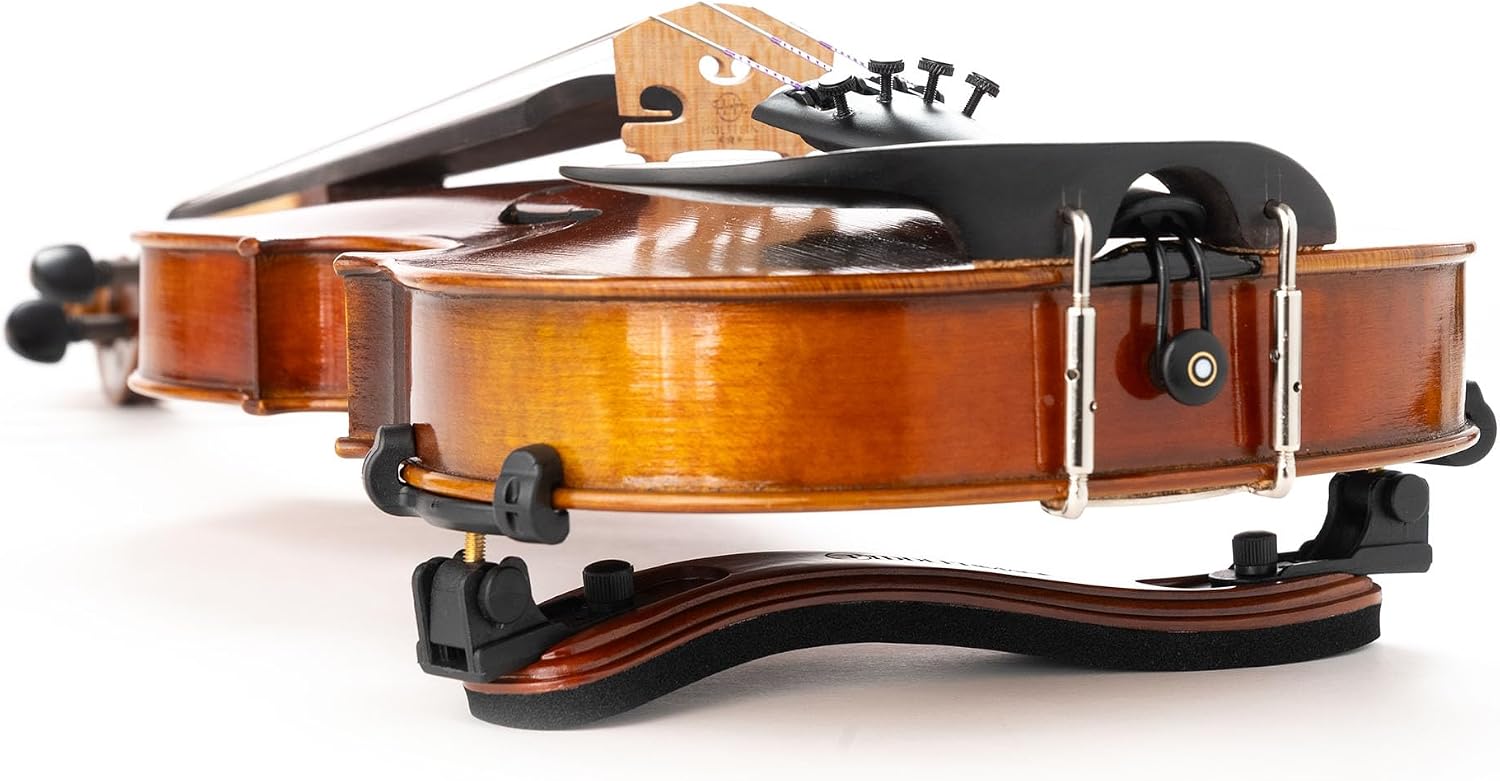
Fiddlerman
$22.89
In stock on Amazon
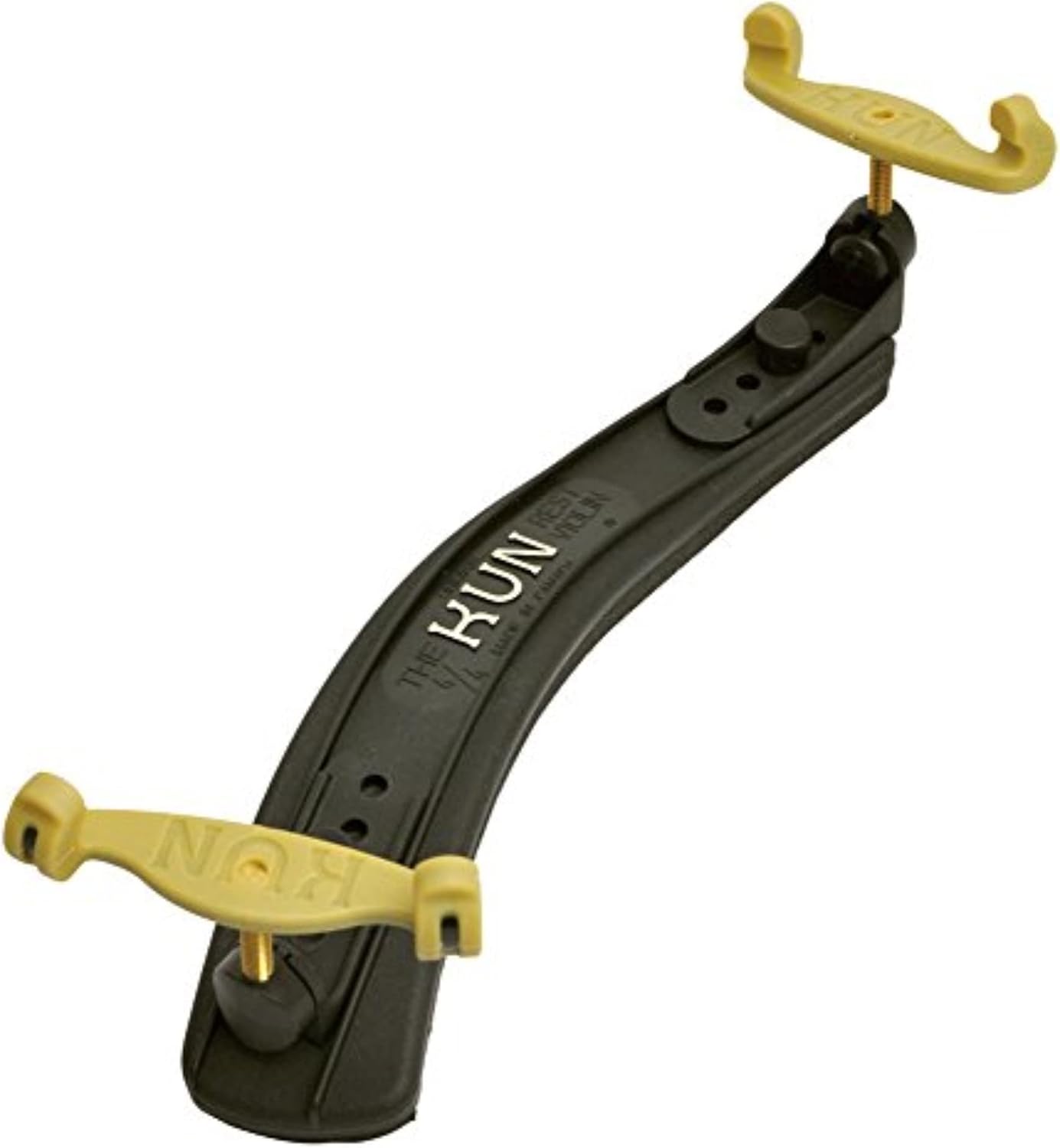
Check price on AmazonThe Kun is the default recommendation for a reason. It fits a wide range of body types, adjusts in both height and width, and has a reputation for foot durability that matters more than it sounds — more on that in the varnish safety section below. The Kun Collapsible variant earns specific praise for one genuinely useful feature: it folds flat and fits inside a standard violin case without requiring a separate bag. Players who travel frequently or share cases with students cite this as a meaningful convenience advantage over the Kun Original, which does not fold the same way.
Where Kun falls short: players with longer necks or more pronounced shoulder slope report that even at maximum height, the Kun doesn’t bridge the gap fully. The result is a subtle but constant compensating tilt — the kind of micro-tension that doesn’t hurt in a 20-minute practice session but accumulates over a four-hour session or a full recording date. Strings Magazine’s buyer guidance recommends confirming that a rest reaches your required height at maximum extension before committing, precisely because no amount of pad adjustment compensates for a fundamentally short column. Kun’s feet have a long track record of durability noted across player discussions on violinist.com, but degraded feet from any brand remain a varnish risk — a point addressed further below.
Fiddlerman
$22.89
In stock on Amazon
Check price on AmazonBonmusica: The Technical Fix for Pivot Problems
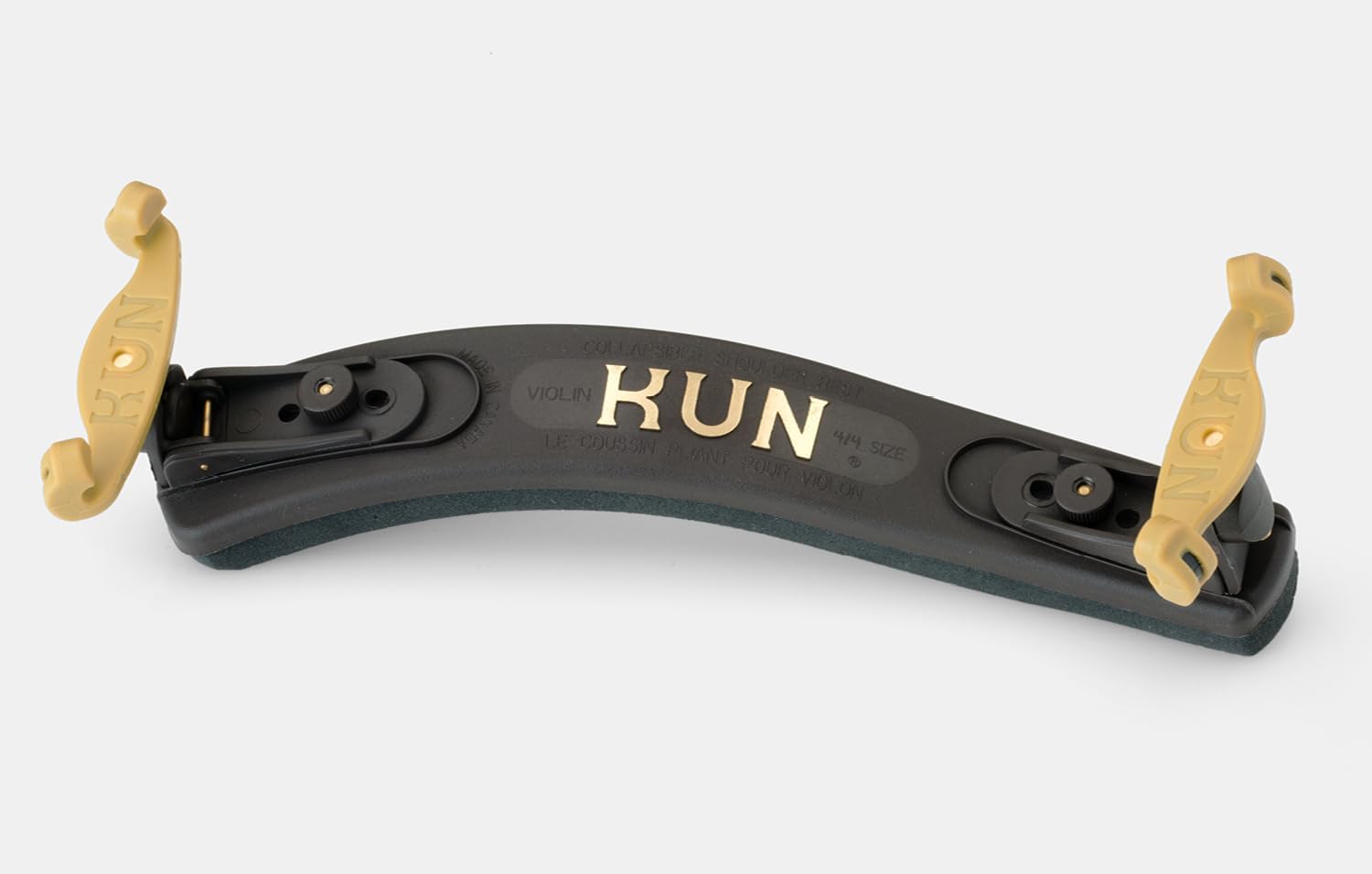
Kun
$28.75
In stock on Amazon
Check price on AmazonThe Bonmusica uses a fundamentally different attachment geometry than any of the other rests in this comparison. Where a Kun hooks under the instrument’s edge with two feet, the Bonmusica wraps over your shoulder with a curved hook while the main body presses against your clavicle and sternum. The mechanical effect is that the rest creates friction at two body contact points instead of one — which eliminates the pivot. That’s not a small thing. Violin pivot (where the scroll slowly drifts left mid-performance as the instrument rotates microscopically on a single-axis rest) is one of the root causes of inconsistent bow angle and unpredictable intonation shift across a set.
The Strad, in their ergonomics feature “Ergonomics and the Violin,” describes this two-point contact principle as central to shoulder rest design innovation over the past two decades — noting that rests which engage both the shoulder and the clavicle simultaneously distribute instrument weight more evenly and reduce compensatory muscle tension in the neck and trapezius.
The tradeoff: the Bonmusica works best for players with a relatively prominent clavicle and moderate neck length. Players with very sloped shoulders or a less defined clavicle shelf report that the over-shoulder hook doesn’t “catch” reliably — the rest can feel less stable, not more. It’s also the most expensive rest in this comparison, which makes the fit question more critical before purchasing. If you’ve never used a Bonmusica and your body type is uncertain, trying one at a shop before committing is worth the detour.
Kun
$28.75
In stock on Amazon
Check price on AmazonEverest: The Alternative Geometry for Kun Refugees
Fiddlerman
$22.89
In stock on Amazon
Check price on AmazonThe Everest EZ-4A doesn’t get as much press as Kun or Bonmusica, but it has a specific champion: players who tried Kun, found it “close but not quite,” and then discovered the Everest. Discussion threads on violinist.com include accounts of players who encountered an Everest already mounted on a shop instrument and immediately noticed that the shoulder contact felt more natural than their Kun — buying the Everest the same day.
What’s different structurally: the Everest’s feet have a wider spacing than Kun’s, and the pad’s curve is engineered with a slightly shallower arc. For players with broader shoulders or a flatter shoulder-to-neck profile, that geometry is a better match. Sweetwater’s product commentary on the Everest notes that the wider foot stance distributes load across more of the instrument’s lower bout, which can reduce the subtle rocking motion that causes pivot in narrow-stance rests.
The question players ask — “will it stay on during a full performance?” — gets a consistent answer from owners in violinist.com discussions: yes, provided the leg clips are adjusted and fully locked before the performance. Slippage reports almost universally trace to legs that weren’t fully secured at the ankle clip before going onstage. Build a pre-show clip check into your setup routine and it’s a non-issue.
Fiddlerman
$22.89
In stock on Amazon
Check price on AmazonFiddlerman Wood Rest: The Pain-Relief Outlier
Kun
In stock on Amazon
Check price on AmazonThe Fiddlerman wood shoulder rest occupies a category of its own, and not just because it’s made of wood. It’s the only rest in this group where player accounts specifically connect it to physical pain relief following a neck or shoulder injury. The slightly different weight distribution and the firmness characteristic of a wooden pad — rather than sponge foam — apparently changes how pressure is distributed across the shoulder contact zone. Players recovering from trapezius or levator scapulae strain report that the unyielding surface lets them find a genuinely neutral shoulder position instead of sinking into foam compression that shifts over time.
The Strad’s ergonomics feature makes a related point: the material stiffness of a shoulder rest’s contact surface affects not only comfort but also vibration transfer, with harder surfaces sometimes preferred by players who feel foam damping affects their instrument’s resonance response under their ear.
The case-fit question is real: the Fiddlerman wood rest fits inside a standard-size violin case without forcing the lid, which matters for players who are tired of carrying a separate rest bag. That said, the Fiddlerman fits a narrower band of body types than Kun — it’s not adjustable in the same granular way, so if your geometry is significantly outside average, it may not be the right primary rest. Think of it as a specialist tool with a specific use case, not a universal replacement. It is also typically the most affordable entry point in this comparison, making it a low-risk experiment for players curious about the wood contact surface.
Kun
In stock on Amazon
Check price on AmazonBy the Numbers: Quick Comparison
| Rest | Best For | Key Limitation | Folds Into Case? |
|---|---|---|---|
| Kun Collapsible | Most body types, travel players | Max height may not suit long necks | Yes |
| Kun Original | Stable everyday use | Doesn’t fold flat; separate bag often needed | No |
| Bonmusica | Pivot problems, defined clavicle | Needs clavicle shelf to lock; highest price | No |
| Everest EZ-4A | Broad shoulders, flat profile | Less-known; try before buying if possible | Partial |
| Fiddlerman Wood | Pain relief, post-injury players | Less adjustable than Kun | Yes |
Cross-Size Compatibility: 3/4 vs. 4/4
This question comes up consistently from players who teach younger students or double on multiple instruments. The short answer: most rests in this group are sized for 4/4 violin, and 3/4 compatibility is a secondary consideration, not a design priority. Kun makes dedicated 3/4 versions, so if you’re shopping for a student instrument, confirm you’re looking at the correct size variant. The Bonmusica’s over-shoulder hook geometry is inherently sized to adult body proportions, making it less suitable for child players. The Fiddlerman wood rest is available in sizing options, but dimensions should be verified before ordering. Everest offers a separate smaller-size model for 1/4–1/2 instruments. The rule: don’t assume cross-size compatibility — confirm before ordering, particularly if you’re buying for a student.
Why Rubber Feet Are a Varnish Safety Issue
Shoulder rest feet are the only points of contact between the rest and your instrument’s finished wood. If rubber feet crack, harden, or degrade, the exposed plastic or metal underneath can gouge or chemically react with varnish — especially nitrocellulose lacquer finishes common on mid-range instruments. Strings Magazine’s buyer guidance feature recommends inspecting rubber feet every six months and replacing them at the first sign of cracking or hardening, regardless of brand. This is especially relevant for players who store instruments in environments with temperature swings — summer festival gear, touring vehicles, uninsulated practice spaces. Foot replacement typically costs $2–5 and protects a four-figure instrument.
Frequently Asked Questions
How do I know which shoulder rest fits my shoulder geometry? Stand naturally, hold your arm at your side, and measure the gap between your collarbone and the angle of your jaw. Players with more than roughly two finger-widths of gap typically need a higher-adjustable rest like the Kun or Bonmusica. Players with very sloped shoulders tend to do better with the Everest’s wider-spaced feet. If you’ve tried Kun at maximum height and still feel tension, that’s the signal to try Bonmusica or Everest.
Is the Bonmusica worth the extra cost over a Kun? If you have a defined clavicle and ongoing pivot problems with your current rest, yes — the mechanical solution is different enough to justify the price delta. If you’ve never tried Kun at all, start there. Most players don’t need the Bonmusica until they’ve confirmed Kun’s geometry doesn’t fully solve their fit problem.
Will the Everest EZ-4A stay on during a full performance? Player accounts on violinist.com confirm yes, reliably — provided both ankle clips are fully locked before the performance begins. Slippage reports almost always trace back to an improperly secured clip. Build a pre-show check into your setup routine and it becomes a non-issue.
Does the Fiddlerman rest really fit inside a standard violin case? Players confirm it does for standard-size cases. The wood construction keeps the profile flat enough to avoid lid-force issues. Shaped cases with very tight instrument cutouts may vary — if your case is already a tight fit, verify dimensions before assuming compatibility.
Can the same shoulder rest work on both 3/4 and 4/4 violin? Generally no. Most rests are sized for a specific instrument. Kun, Everest, and Fiddlerman all make size-specific variants. Confirm the size designation before ordering, particularly if buying for a student or doubling on a smaller instrument.
Why do rubber shoulder rest feet matter for protecting my violin’s varnish? The feet are the only contact points between the rest and your instrument’s finish. Degraded or cracked rubber exposes harder material that can scratch or react chemically with varnish. Inspect feet every six months and replace at the first sign of cracking — it’s a low-cost fix that protects your instrument.
The Decision Rule
If you’ve never owned a quality shoulder rest and want the widest compatibility: start with the Kun Collapsible — it fits most body types, adjusts meaningfully, and the fold-flat design solves a real daily-use friction point.
If you’ve used Kun and still experience pivot, inconsistent scroll height, or bow angle drift: try the Bonmusica — but only if your clavicle geometry gives the over-shoulder hook something to lock against.
If Kun felt “close but not right” and you have broader shoulders or a flatter shoulder-to-neck profile: the Everest is worth an in-shop trial before committing.
If you’re managing a neck or shoulder injury and need different pressure distribution across the contact zone: the Fiddlerman wood rest is the player-reported option specifically linked to pain relief — make it a conversation-starter with your luthier or physical therapist.
Your next step: if you’re unsure of your geometry, visit a local luthier or violin shop and ask to try each rest on your instrument for five minutes each. The Strad’s ergonomics feature “Ergonomics and the Violin” makes the point plainly — a rest that feels wrong in the first 30 seconds of a trial won’t feel better after six months. Buy the one that fits, not the one that’s popular.