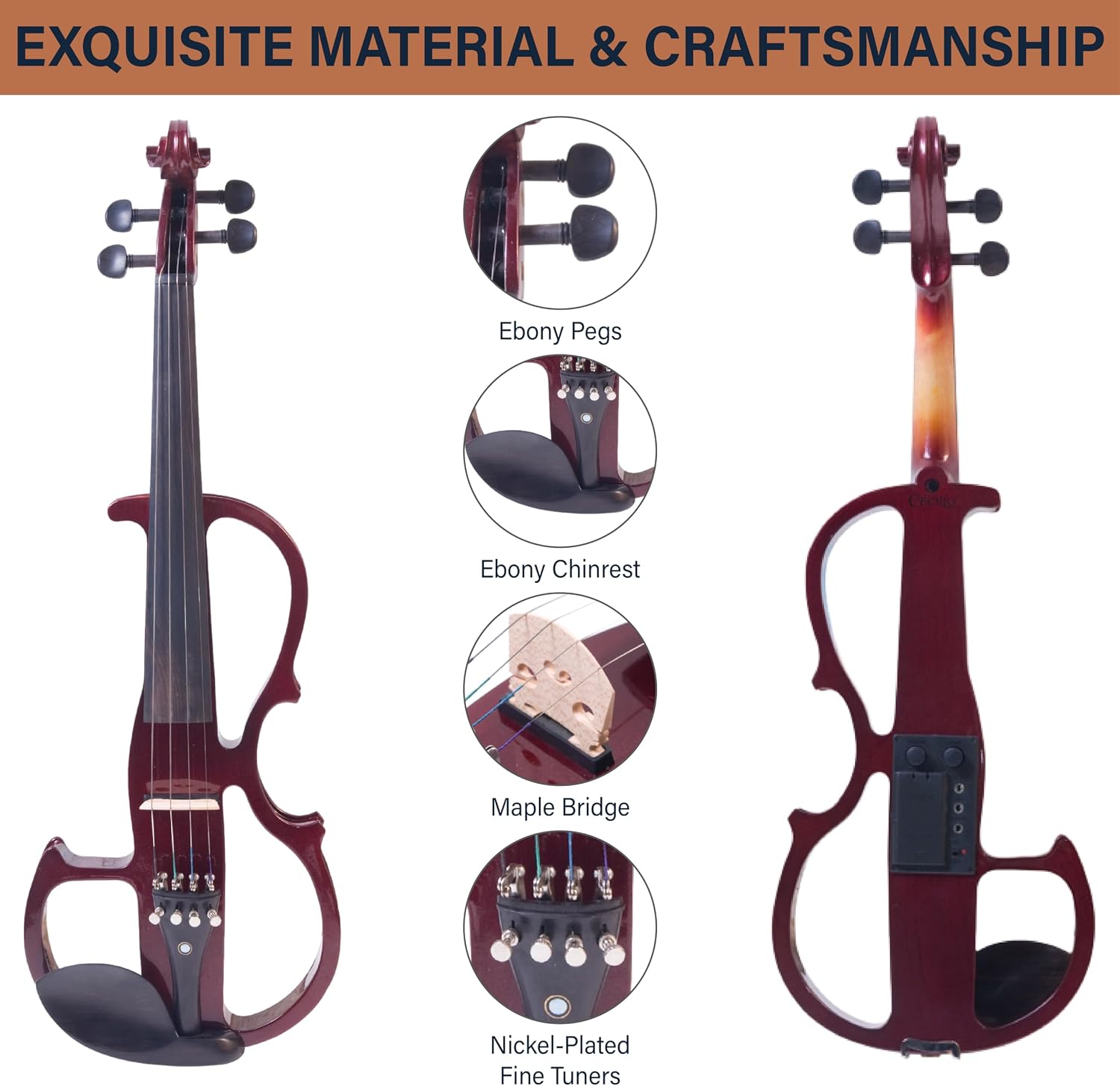
So you’re looking at electric violins under $200, and the three names that keep surfacing are Cecilio, Vangoa, and Pyle. Maybe you’re a beginning player who wants to practice late at night without waking anyone. Maybe you’re a curious musician picking up a second instrument. Either way, you’ve probably noticed that the marketing for all three brands looks nearly identical — full outfit bundles, glossy photos, bullet points about “professional quality.” The question is whether any of them actually deliver.
An electric violin is a violin (or violin-shaped instrument) that produces its primary sound through a pickup — an electronic sensor — rather than through an acoustic wooden body. You plug it into an amplifier or headphone amp to hear it properly. The pitch at which these entry-level instruments are positioned is somewhere between “toy” and “real instrument,” and figuring out exactly where each one lands is what this article is for. By the end, you’ll have a clear decision frame: which instrument fits which buyer, and when it makes more sense to stretch your budget instead.
| EDITOR'S PICKPyle Full Size Electric Violin… | Mid-tierCecilio Solid Wood Electric/Sil… | Budget pickCecilio Electric Violin 4/4 Ful… | |
|---|---|---|---|
| Case included | ✓ | — | — |
| Bow included | ✓ | — | — |
| Tuner included | ✓ | — | — |
| Finish | — | Metallic red | Metallic black |
| Body wood | Solid wood | Solid wood | Solid maple |
| Price | $199.99 | $151.99 | $119.99 |
| See on Amazon → | See on Amazon → | See on Amazon → |
What You’re Actually Buying in the Sub-$200 Tier
Let’s be direct about what this price range means structurally. All three brands — Cecilio, Vangoa, and Pyle — source their instruments through similar overseas manufacturing pipelines. Published specs across these product lines show roughly comparable construction: laminate tonewoods, basic piezo pickups (piezo meaning a crystal-based sensor that converts vibration to an electrical signal), and passive onboard electronics. You are not getting hand-fitted components, properly seasoned tonewoods, or quality-controlled setup work at this price. That is not a knock — it is just an accurate description of the category.
What differentiates these instruments at the buyer level is not raw materials. It is consistency off the assembly line, completeness of the bundle, and how forgiving the setup process is for someone who may have never assembled a violin before. Those are the variables that determine whether a sub-$200 electric violin becomes a useful learning tool or a frustrating shelf ornament.
By the Numbers
| Brand | Street Price Range | Bundle Contents | Pickup Type |
|---|---|---|---|
| Cecilio CEVN-1 | ~$100–$130 | Violin, bow, rosin, cable, case | Passive piezo |
| Vangoa 4/4 Electric | ~$130–$160 | Violin, bow, rosin, cable, headphone amp | Passive piezo |
| Pyle PVNELK20 | ~$80–$120 | Violin, bow, rosin, cable, case | Passive piezo |
Prices observed May 2026; bundle contents vary by listing revision.
Cecilio CEVN-1: The Benchmark (and Its Cracks)
What the Cecilio Gets Right
The Cecilio CEVN-1 has the longest track record of the three in aggregated owner reviews, and that history cuts both ways. On the positive side, owners consistently report that the instrument arrives playable — strings installed, pegs functional, and the basic setup close enough that a beginner can start bowing within an hour of unboxing. MusicRadar’s roundup of entry-level electric violins (titled “Best electric violins for beginners”) notes Cecilio as a frequently cited starting point in the under-$150 conversation, specifically because the out-of-the-box experience tends to be more consistent than competing options at the same price.
Where It Falls Short
The complaints, however, are specific and recurring enough that they deserve explicit naming. A notable pattern across owner reviews is uneven paint finish: thin spots, minor inconsistencies at the edges, and in at least one documented case, visible hairline cracks along the neck seam. That last detail matters structurally — a neck seam crack is not a cosmetic issue, it is a potential point of failure under string tension. Strings Magazine’s buyer guidance overview, “Getting Started on Electric Violin,” emphasizes that neck joint integrity is the single most important structural checkpoint on any inexpensive stringed instrument.
There is also a quality-consistency footnote worth knowing: community discussions aggregated on Violinist.com note that experienced players who have handled multiple units find the Cecilio’s variance wider than the brand’s popularity might suggest. The instrument’s value proposition depends heavily on receiving a well-finished unit from the production run.
The honest frame: If you receive a well-finished unit, the Cecilio CEVN-1 is probably the most approachable entry point in this comparison. If you receive a unit with finish or joint issues, your recourse is a return process. Buy from a retailer with a clear return window.
Cecilio
$119.99
In stock on Amazon
Check price on AmazonVangoa: The Complete Bundle Argument
What the Vangoa Gets Right
Vangoa’s main differentiator in this tier is bundle construction. Where the Cecilio requires you to source an amplifier or headphone amp separately, the Vangoa package typically includes a small headphone amplifier — a pocket-sized device that lets you plug in headphones and hear yourself without a full amp rig. For an apartment player whose primary goal is silent practice, this is a meaningful practical advantage. Owners with prior string experience consistently rate the Vangoa as an acceptable value when the full bundle is factored in.
Where It Falls Short
The critical caveat is significant: the instrument is aimed at players who can compensate for entry-level shortcomings. Per community discussions aggregated on Violinist.com, experienced players picking up electric violin as a second instrument tend to rate instruments in this tier much more generously than true beginners — because they already have the ear and hand calibration to compensate for shortcomings like slightly high action (the distance between the strings and the fingerboard) or uneven string response. A violin with those characteristics will punish a brand-new player far more than it will punish someone with even six months of prior string experience.
A beginner who purchased the Vangoa expecting an immediately playable instrument with zero prior experience is the mismatch case this instrument is most likely to produce. The instrument is probably not dramatically worse than the Cecilio. The failure mode is the gap between the instrument’s quality floor and the absolute beginner’s need for immediate playability feedback.
The honest frame: The Vangoa bundle is the best “everything included” proposition in this comparison. It is the right choice for the player who has some string background and wants a single-purchase solution. It is a risky choice for a complete beginner with no prior instrument experience.
Cecilio
$119.99
In stock on Amazon
Check price on AmazonPyle: The High-Variance Option
What the Pyle Gets Right
Pyle occupies the lowest price point of the three, and at its best, that is its entire value proposition. Multiple buyers call the Pyle a “great learning bargain” — functional enough to determine whether violin is worth pursuing, and priced low enough that sunk-cost anxiety is minimal. For a player whose only question is “do I even want to do this?” the Pyle answers that question at the lowest possible financial commitment.
Where It Falls Short
The owner review pattern reflects a wider quality variance than either competitor. On the problematic end, documented issues include bows that arrived non-functional and output cables with factory-frayed shielding. Sound On Sound’s technical explainer “Electric Violin Pickups and Amplification” specifically flags cheap factory cables as a common failure point in entry-level setups, noting that a frayed or poorly shielded cable can produce hum and dropouts that beginners frequently misattribute to the instrument itself rather than the cable. A bow failure on first use is a more severe problem — without a functional bow, the instrument is unplayable until a replacement arrives.
To be clear: a single extreme review does not make a product categorically defective. But the Pyle’s quality control variance appears wider than Cecilio’s based on aggregated owner reports, which means the odds of receiving a problem unit are meaningfully higher. At $80–$100, you are paying partly for that variance. A decent beginner replacement bow runs $30–$60, which erodes the price advantage quickly if yours fails.
The honest frame: The Pyle is the right call only if your goal is the absolute lowest cost of entry and you are genuinely comfortable with a meaningful chance of receiving an inconsistent unit. Budget mentally for possible bow and cable replacement.
Cecilio
$119.99
In stock on Amazon
Check price on AmazonThe “Silent” Practice Question: What These Instruments Actually Sound Like Unplugged
This comes up in reviews across all three brands, and it is important enough to address directly. Multiple owners, independently and across all three brands, report that these instruments are not truly silent when unplugged. The body still vibrates, and in a quiet room — an apartment at midnight, a thin-walled townhouse — that acoustic bleed is audible. It is quieter than an acoustic violin, but it is not inaudible.
This is a physics reality of violin construction, not a defect. Sound On Sound’s “Electric Violin Pickups and Amplification” overview explains that any instrument with a resonant wooden body will produce some acoustic output regardless of whether it is plugged in. Solid-body electric violins — instruments without a hollow resonance chamber — are quieter unplugged, but they cost considerably more and occupy a different product category entirely. At sub-$200, you are getting a semi-hollow or thin-body instrument with real acoustic bleed. Manage your expectations accordingly.
Frequently Asked Questions
Is a budget electric violin actually quiet enough for apartment practice? Quieter than an acoustic violin, yes — but not silent. Owners across Cecilio, Vangoa, and Pyle units consistently report that body vibration is still audible in a quiet room. If true silence is a hard requirement, a headphone amp will shift your focus to the amplified signal, but the instrument will still produce some physical sound.
Why does my electric violin still make noise when unplugged? Because the wooden body still vibrates when you draw a bow across the strings. The pickup captures that vibration and converts it to an electrical signal, but the vibration itself produces sound regardless. This is normal and expected in any instrument with a resonant body.
The bridge came uninstalled — is that normal? Yes, completely normal across all violin types, including acoustic instruments. The bridge is shipped flat in the case to prevent warping in transit. You fit it upright under the strings, aligned with the f-hole notches, and string tension holds it in place. Violinist.com’s community resources and many freely available instructional videos walk through this process clearly. Take your time — rushing bridge placement is one of the most common causes of a broken string on first setup.
How do I stop the pegs from slipping? Friction pegs slip when they dry out or when the fit between peg and pegbox loosens. Peg compound — a chalk-and-soap product available at most music retailers — applied to the peg shank can restore grip. A light twist-and-push motion when tuning helps seat the peg. If slipping persists severely, the pegbox hole may be out of tolerance, which is worth raising with the seller.
Is the included bow usable or should I replace it immediately? The bows included in sub-$200 bundles range from marginally functional to genuinely problematic. Owners across all three brands note that included bows often arrive under-tensioned and may require more rosin than a quality bow. The Pyle’s bow has drawn the most severe complaints. A basic fiberglass replacement bow in the $25–$45 range is a worthwhile upgrade once you decide you are committed to continuing.
Should I buy an $80 electric violin or save up to the $300+ range? If you are genuinely testing whether you want to play violin at all, the sub-$200 tier is defensible. If you have already played violin or another string instrument and know you want to continue, the $300–$500 range will give you meaningfully better playability, more consistent electronics, and a longer usable life before you outgrow the instrument. MusicRadar’s “Best electric violins for beginners” roundup identifies the mid-tier bracket — instruments like the Bridge Draco and Yamaha YEV-104 — as the point where construction quality begins to reward rather than fight the developing player. The math is straightforward: if you spend $100 and hate the experience because the instrument fights you, then spend $400 on something better, you have spent $500 total. Starting at $400 saves money and frustration if you already know you are committed.
The Decision Rule
Here is the “if X, then Y” frame this comparison is designed to produce:
- If you are a true beginner with zero string background and a hard $150 budget: The Cecilio CEVN-1 is the lowest-risk entry point based on aggregate owner reports. Buy from a retailer with a return window and inspect the neck seam immediately on arrival.
- If you want a complete bundle including a headphone amp and have some prior string experience: The Vangoa bundle is the most practical single-purchase solution in this tier.
- If your only constraint is absolute minimum spend and you accept variance risk: The Pyle is the price leader, but budget $30–$60 mentally for a possible bow replacement.
- If you have played any string instrument before and are serious about continuing: Skip this tier entirely. The mid-range instruments in the $300–$500 bracket will serve you better from the first session, and the instruments in this comparison will frustrate rather than motivate you.
Your next step: if you are leaning toward the mid-range after reading this, the Yamaha YEV-104 comparison guide on this site gives you a clear look at what another $300–$400 actually buys in playability and electronics. That is the decision worth making carefully.