If you’ve ever stood in the wings of a noisy session, tried to tune up between tunes, and realized you genuinely cannot hear your own instrument over the din — you already understand why a clip-on tuner matters. A clip-on tuner is a small electronic device that attaches directly to the headstock (the top end of your violin’s neck, where the tuning pegs live) and reads pitch by sensing the physical vibrations of the wood, rather than picking up sound through a microphone. That means ambient noise is irrelevant. The tuner “hears” your instrument even when the room doesn’t cooperate.
For a beginning violinist, getting the string names right — G, D, A, E, from lowest to highest pitch — is already a mental load. A tuner that introduces confusion on top of that is actively harmful to learning. That’s why this comparison matters more than the price tags suggest. The Fender FCT-2 and the ENO ET-05SV both cost less than $20, but the real cost of choosing the wrong one is measured in frustrated practice sessions and wrong muscle memory. Here’s what the evidence actually shows.
| EDITOR'S PICKFender FCT-2 Professional Multi… | Budget pickENO MUSIC Professional Violin V… | |
|---|---|---|
| Compatibility | Guitar, Bass, Ukulele, Violin | Violin, Viola |
| Display | — | Colorful LCD |
| Controls | — | Easy Control |
| Accuracy | — | Accurate |
| Tuning Modes | Multi-Instrument | — |
| Price | $23.99 | $18.99 |
| See on Amazon → | See on Amazon → |
What Each Tuner Does Well: The Honest Summary
Fender FCT-2
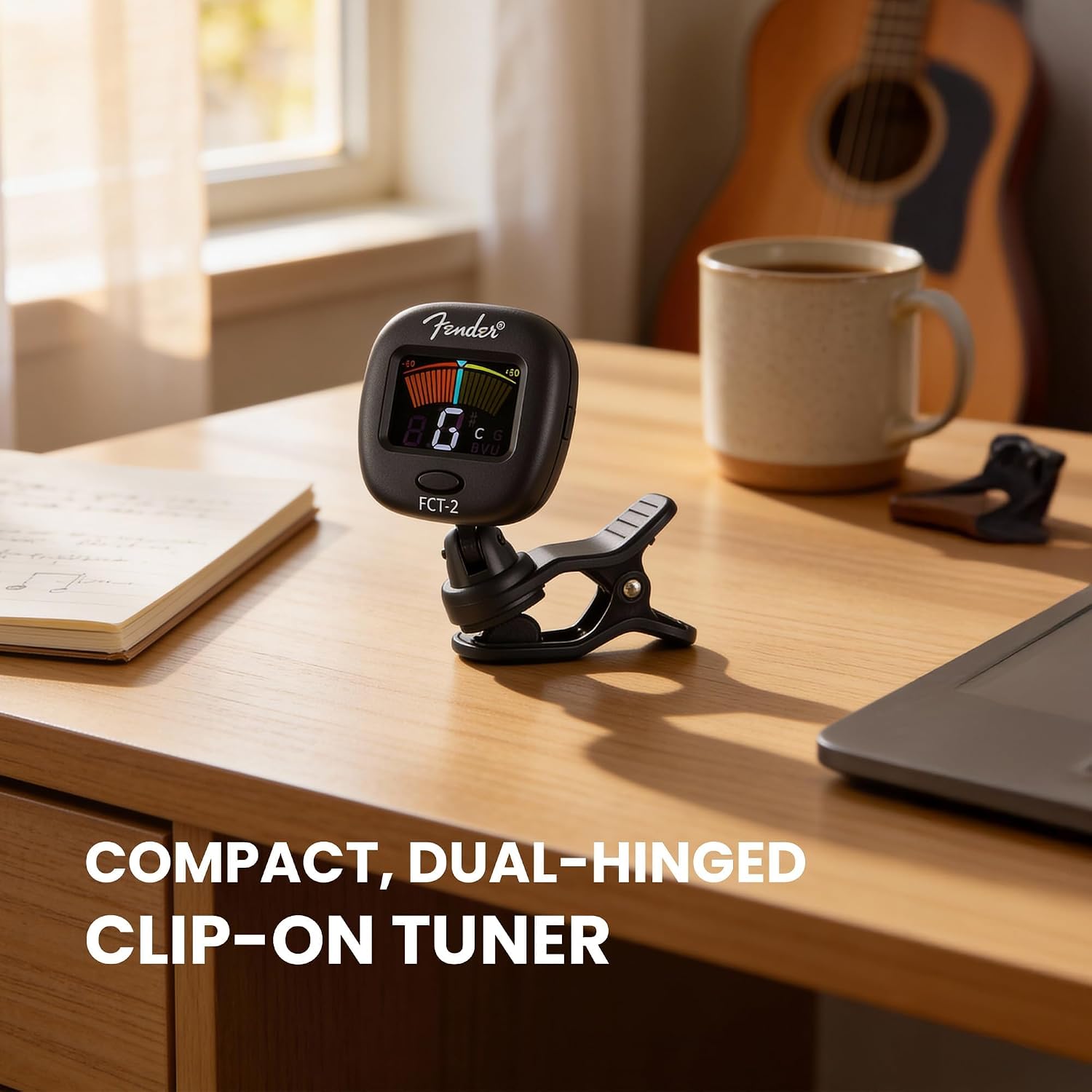
The Fender FCT-2 is a chromatic clip-on tuner — “chromatic” means it can detect and display any of the twelve notes in Western music, not just the four open strings of the violin. That matters more than it sounds. When you’re fine-tuning a string that’s way off, a chromatic display shows you exactly which note you’re closest to and which direction to go, rather than just flashing “wrong.” Owners on aggregated review threads consistently praise its speed: the needle response is described as fast and stable, meaning the display settles on a reading quickly rather than wavering. Multiple reviewers specifically note it handles the full range of string instruments without reconfiguration — violin, banjo, cello, and guitar all respond cleanly without mode-switching.
Sweetwater’s product overview for the Fender FCT-2 Clip-On Tuner confirms multi-instrument compatibility as a designed feature, not an accident. For a household where multiple instruments share the instrument cabinet — a common scenario in folk and Celtic households where someone plays fiddle, someone else plays banjo, and the guitar is always getting dragged out — that’s a practical convenience that adds real daily value.
The display is described across owner reviews as clear and legible in dim stage lighting, which is a non-trivial consideration for working fiddlers. “No fuss” appears repeatedly in owner language, which in this context means: you clip it on, you see a note name and a needle indicator, you tune. There’s no owner-reported learning curve.
ENO ET-05SV
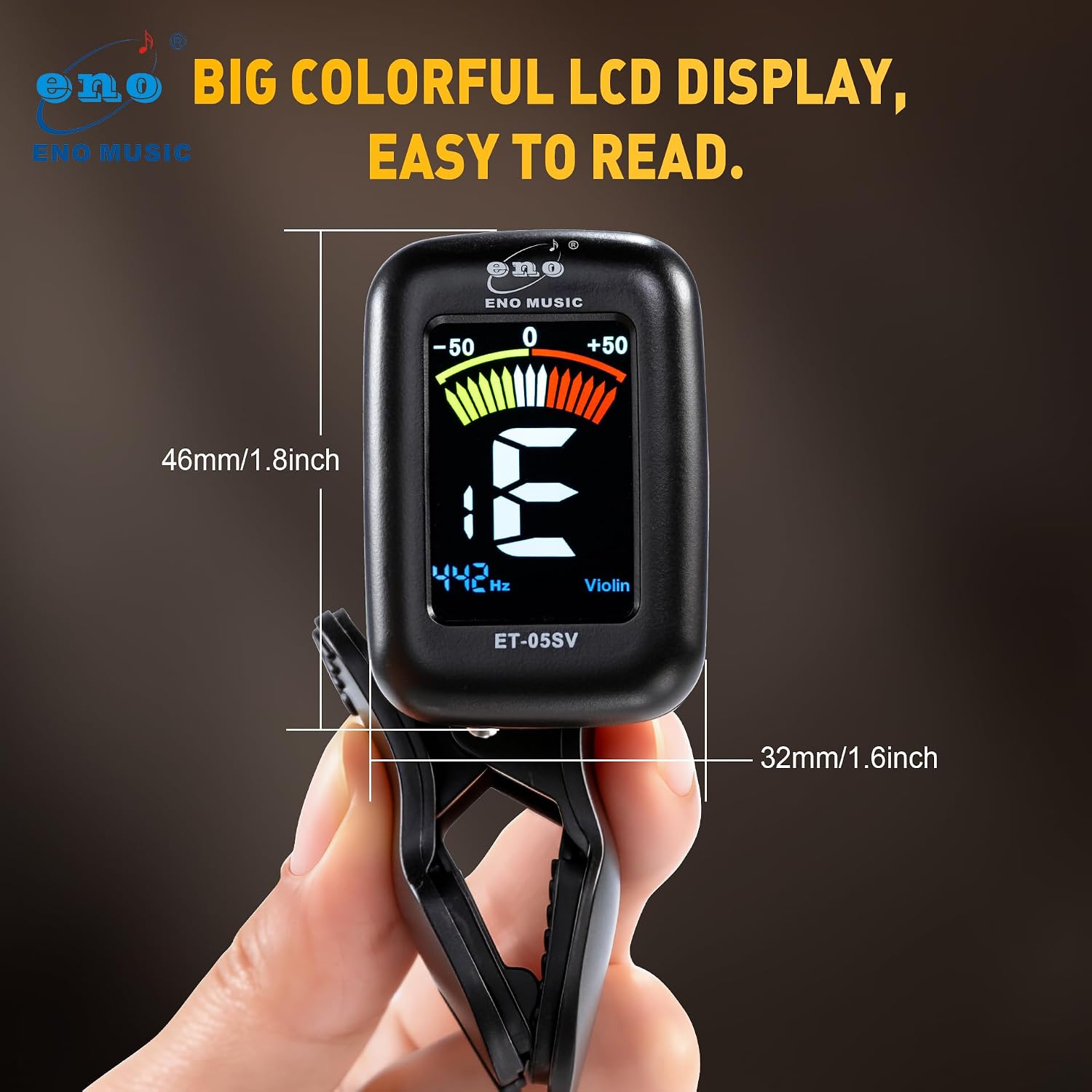
The ENO ET-05SV is purpose-built for violin — the “SV” designation stands for “string violin,” and the packaging and default calibration target the four-string violin range specifically. For accuracy on those four strings, owners report strong results. One novice violinist’s account, surfaced in aggregated review threads on Violinist.com community forums, is particularly credible: they confirmed the tuner’s readings against both their instructor’s ear and a separate electronic reference device, and all three agreed. That’s a meaningful data point. Accuracy at the $15 price point isn’t guaranteed, and the ET-05SV apparently delivers it.
The recurring problem, however, is a display rendering flaw that owners flag consistently enough to warrant taking seriously. The G string — the lowest, thickest string on a violin and one of the four you’ll be tuning every single time you play — displays in a way that reads visually as a “C with a tail” rather than a clear “G.” Reviewers explicitly describe this as a confidence problem for beginners who are still learning their note names. If you’re a new player who isn’t yet certain which note name maps to which string, a tuner display that shows you an ambiguous character is actively undermining your learning. You can’t trust what you can’t read.
Owners also note the device is smaller than the product photography suggests, which isn’t inherently a flaw but does affect how easy it is to read the display quickly at a gig.
MusicRadar’s 2025 guide to clip-on tuners for string instruments notes that display clarity and note-name legibility are consistently the most-cited practical differentiators in the sub-$25 segment — spec accuracy is table stakes at this price point, but the display experience is where products actually diverge in daily use.
Head-to-Head: Three Decision Scenarios
The following three subsections break down the FCT-2 and ET-05SV across the buyer profiles that actually purchase these products. Read the one that matches your situation.
For the Complete Beginner or Student
A beginning violinist is still building the automatic association between a note name, its position on the fingerboard, and its sound. Every piece of gear in the learning environment should reduce cognitive load, not add to it. On this criterion, the Fender FCT-2 is the stronger choice.
The FCT-2’s chromatic display shows a clear, unambiguous note name alongside a needle indicator that shows sharp, flat, or in-tune at a glance. Owners report no confusion reading the display under stage lighting or in a practice room. The Sweetwater product overview for the Fender FCT-2 specifically describes the display design as optimized for fast, readable feedback — a deliberate engineering choice, not an incidental outcome.
The ENO ET-05SV, by contrast, has a documented display rendering issue on the G string that Violinist.com community forum threads describe repeatedly: the segmented LCD renders “G” in a way that reads visually like “C with a descender.” For a student who doesn’t yet have the string names memorized as reflex, this is an active obstacle. The tuner’s accuracy is real — owner cross-referencing confirms it — but accuracy you can’t read clearly doesn’t serve a learner.
ENO
$18.99
In stock on Amazon
Check price on AmazonFor the Violin-Only Household on a Tight Budget
If you play only violin, you’ve been playing long enough that you know your string names cold, and price is the primary constraint — the ENO ET-05SV is a legitimate option. Its violin-specific tuning mode is accurate. Strings Magazine’s 2024 feature “Tuning Up: Tools for the Modern String Player” notes that purpose-built instrument modes can offer slightly faster note acquisition on the target instrument compared to generic chromatic modes, because the device’s detection algorithm is optimized for that pitch range. For a player who already knows that the lowest string is G regardless of what the display renders, the ET-05SV’s accuracy delivers real value at its price point.
The display quirk is a real limitation. But for an experienced enough player, it’s a known quantity you can work around. You see the ambiguous character, you know it means G, you proceed. That’s not ideal tuner design — it’s a workaround — but it’s a workable one for someone who isn’t building foundational note knowledge at the same time.
ENO
$18.99
In stock on Amazon
Check price on AmazonFor Multi-Instrument Households and Working Fiddlers
This is where the Fender FCT-2 creates a genuine distance between the two products. If you play violin and your partner plays guitar, or you’re picking up banjo as a second instrument, or your kid is starting on cello, the FCT-2 covers all of those without any reconfiguration. Owners reporting multi-instrument use describe it as genuinely transparent: clip it on, tune, go. No mode-switching, no manual consultation.
The ENO ET-05SV’s violin-specific tuning is a feature for violin-only households and a limitation for everyone else. That’s not a flaw in the product’s design — it’s doing exactly what it’s designed to do — but if your tuner is going to live in a shared instrument space or travel with you to sessions where you might hand it to a bandmate, versatility has real value. MusicRadar’s 2025 clip-on tuner guide identifies multi-instrument range as one of the top decision criteria for players in folk and traditional music contexts specifically, where instrument doubling is common.
For working fiddlers who need a tuner that handles the chaos of a loud session room and then gets handed to the banjo player across the table, the FCT-2 is the practical call.
Fender
$23.99
In stock on Amazon
Check price on AmazonThe G-String Display Problem: What’s Actually Happening
This deserves its own section because it comes up consistently enough in owner feedback that dismissing it as a quirk would be editorially dishonest.
The ENO ET-05SV uses a segmented LCD display — the same type of screen technology used in digital clocks and basic calculators. These displays render letters by lighting up specific segments of a grid. The lowercase or stylized version of “G” on a segmented display can look nearly identical to a “C” with an added descender, depending on font design and viewing angle. Violinist.com community threads on entry-level tuners describe this exact phenomenon with multiple similar devices: the G segment rendering is an industry-wide LCD design challenge, not unique to ENO, but ENO owners report it more consistently than owners of competing products at the same price point.
For a player who already knows their violin strings cold, this is a minor annoyance. For a beginner who is still building the automatic association between the note name “G” and the feel and sound of that string, it’s a real pedagogical obstacle. Strings Magazine’s 2024 feature “Tuning Up: Tools for the Modern String Player” specifically identifies display legibility as a factor that disproportionately affects beginners, noting that any source of ambiguity in a learning tool compounds the cognitive load of early instrument study.
The display issue doesn’t mean the tuner is broken or inaccurate. It means the accuracy is trustworthy, but the readability creates confusion. Those are different problems, and precision about which one you’re dealing with matters.
Accuracy Ceiling: Is a Clip-On Enough for Serious Playing?
This question comes up in Violinist.com community discussions regularly: at some point, does a clip-on vibration tuner become a limitation rather than a convenience?
The honest answer is that for pitch reference and open-string tuning, the accuracy of both these devices is sufficient for conservatory-level practice. What conservatory-level playing demands beyond basic tuning accuracy is intonation training within phrases, which no clip-on tuner can address because intonation is about relative pitch relationships during playing, not open-string reference. A clip-on tuner gets your open strings in tune. What you do with that foundation is a technique question, not a gear question.
For performance tuning in variable temperature environments — backstage at an outdoor festival where temperature swings affect string tension — experienced players often use a clip-on for a quick pre-show check and then fine-tune by ear. That workflow doesn’t require a $200 tuner; it requires a reliable one.
The Sweetwater product overview for the Fender FCT-2 lists an accuracy specification of ±1 cent, which is standard for clip-on tuners in this price tier. The ENO ET-05SV does not publish a comparable specification in its standard product documentation, but owner cross-referencing against professional electronic references, as reported in Violinist.com forum threads, suggests it operates in the same general accuracy range for the violin string pitches it targets.
The Clear Decision Rule
Here’s where this lands:
If you’re a beginner violinist, or you’re buying this for a student: Choose the Fender FCT-2. The G-string display ambiguity on the ENO ET-05SV is not a quirk you want a new learner navigating. The FCT-2’s display is clean, its speed is praised by owners, and it won’t introduce confusion when the whole point of the tuner is to reduce confusion.
If you play only violin and price is the primary constraint: The ENO ET-05SV is accurate — confirmed by owner cross-referencing against professional references on Violinist.com. If you already know your string names cold and won’t be thrown by the G display rendering, the accuracy is real and the price is right.
If you play multiple instruments, or live in a household with multiple instruments: The Fender FCT-2 is the obvious call. Multi-instrument owners report it works without adjustment across violin, banjo, guitar, and cello. The ENO is a violin tool. The FCT-2 is a universal one.
Frequently Asked Questions
Does the Fender FCT-2 work accurately on violin, not just guitar? Yes. Owners specifically report using it on violin, cello, banjo, and guitar in the same household without issues. The chromatic mode reads the full pitch range of all four violin strings cleanly, and the Sweetwater product overview for the FCT-2 confirms this multi-instrument range as a core design feature.
What does it mean when the ENO shows a ‘C’ instead of ‘G’ — is the tuner broken? The tuner isn’t broken. It’s a display rendering issue: the segmented LCD screen renders the letter G in a way that reads visually like a C with a descender. The underlying tuning accuracy is still sound, but the display is ambiguous. Violinist.com community forum discussions confirm this is a known quirk reported by multiple owners, not a malfunction.
Which tuner is better if I’m also learning banjo or guitar? The Fender FCT-2. It’s chromatic and multi-instrument by design. The ENO ET-05SV is violin-specific and will not serve banjo or guitar tuning the way the FCT-2 does.
Is a clip-on tuner accurate enough for a conservatory-level player or just beginners? Accurate enough for open-string reference tuning, yes. Intonation development within phrases requires ear training and technique — no clip-on tuner addresses that. Both devices at this tier are sufficient for getting your open strings in tune before a lesson or rehearsal.
Can I leave a clip-on tuner on my violin while it’s in the case? Physically, yes — neither the FCT-2 nor the ENO ET-05SV has owner-reported issues with clip pressure damaging instruments. Practically, most players remove the tuner before casing the instrument to avoid any sustained pressure on the scroll over long storage periods and to preserve battery life. It’s a low-risk habit either way.
Your next step: if you’re buying for a beginner or a multi-instrument household, the Fender FCT-2 is the name to search. If you want to dig deeper into how clip-on tuners compare to pedal tuners for stage use — a relevant question once you’re running a signal chain — check the ElectricFiddles.com guide to stage tuning solutions for electric violin and fiddle.