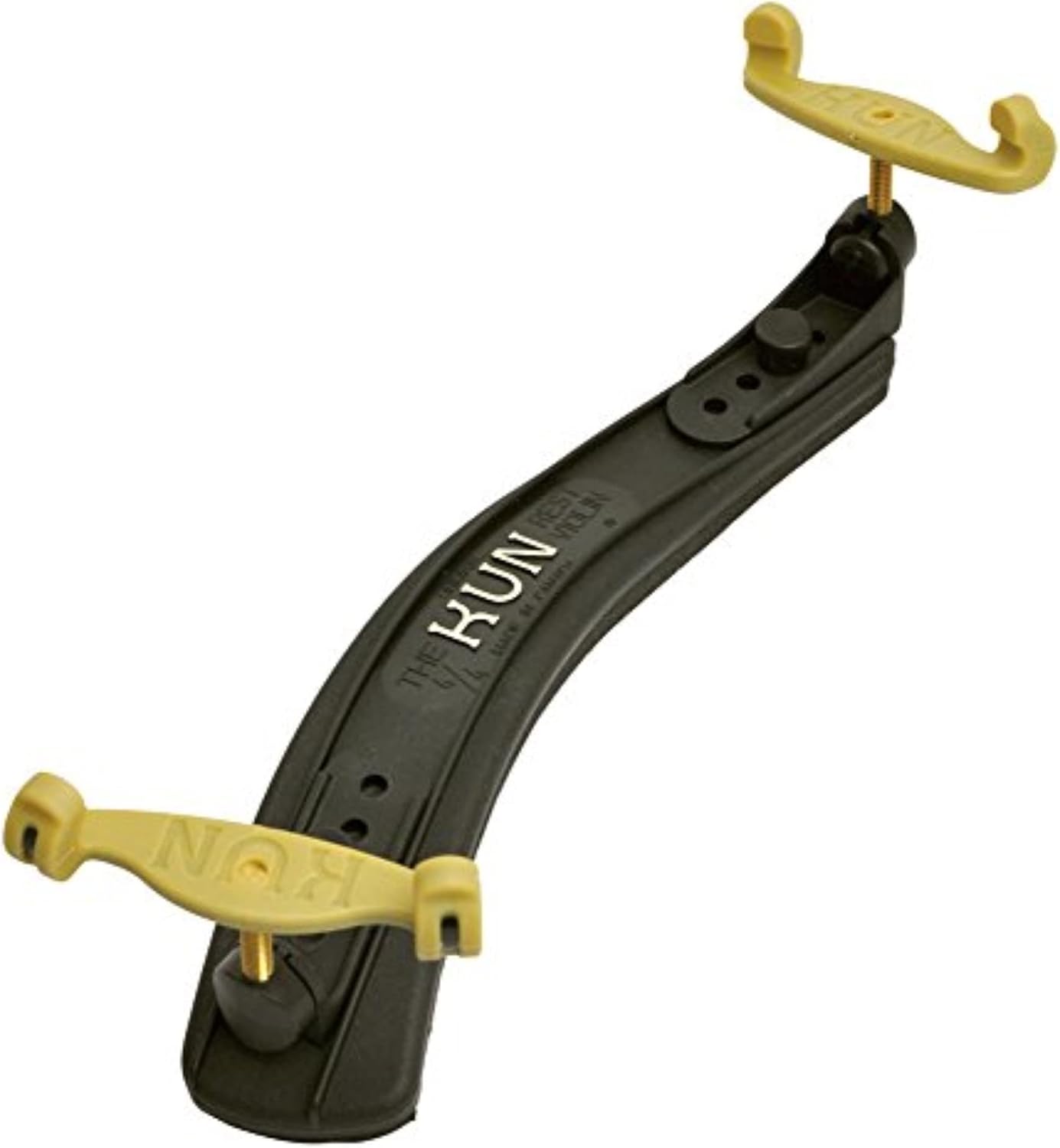
If you’ve ever set your electric violin on your shoulder only to feel it shift, slide, or sit at an awkward angle mid-performance, you already understand why a shoulder rest matters. A shoulder rest is a curved, cushioned bracket — usually made of plastic, wood, or carbon fiber — that clamps to the lower bout (the wide bottom end) of the violin body and bridges the gap between the instrument and your shoulder. For acoustic players, this is a decades-old conversation. For electric violin players, it’s trickier: solid-body electrics are often thinner, differently shaped, and made of materials that don’t grip clamps the same way a spruce top does. The wrong rest can slip mid-set, create fit problems, or simply never feel right. This guide ranks six shoulder rests specifically through the lens of electric violin use — comparing adjustability, clamp fit, ergonomic benefit, and how real owners describe each one — so you can make a confident call before you spend.
| EDITOR'S PICKKun Collapsible Shoulder Rest -… | Mid-tierFiddlerman Wood Violin Shoulder… | Budget pickKun Original - 4/4 Violin Shoul… | |
|---|---|---|---|
| Fits size | 4/4 | 4/4 & 3/4 | 4/4 & 3/4 |
| Collapsible | ✓ | ✓ | — |
| Height adjust | — | ✓ | — |
| Material | — | Wood | — |
| Brand | Kun | Fiddlerman | Kun |
| Price | $28.75 | $22.89 | |
| See on Amazon → | See on Amazon → | See on Amazon → |
Why Electric Violin Body Shape Changes Everything
Here’s the core problem acoustic-focused reviews don’t address: most shoulder rests are designed around a traditional violin’s arched, approximately 1.5-inch-deep body. Many electric violins — the Yamaha YEV-104, the NS Design CR Series, the Bridge Draco — have bodies that are dramatically thinner, flatter, or shaped without a traditional lower bout at all. Clamps that grip an acoustic violin securely can sit loose, angle incorrectly, or simply refuse to seat on a solid-body instrument.
Reviewers on violinist.com’s community boards flag this repeatedly. One user specifically noted that a carbon fiber rest they purchased had to be carefully repositioned to work on a Yamaha SV-250 because the electric violin’s thin body created a fit question they had to work through before it felt stable. This isn’t unusual — it’s the rule, not the exception. Before committing to any rest, check the clamp jaw opening range against your instrument’s body depth. Most manufacturers publish this in the spec sheet; treat it as a hard filter, not a secondary concern.
Strings Magazine’s ergonomics overview notes that shoulder height, chinrest height, and neck angle all interact — meaning a rest that works beautifully on a 4/4 acoustic might put your bowing arm in a subtly wrong position on an electric with a flatter profile. If you’re performing regularly, that subtle misalignment compounds over a two-hour set.
The Six Shoulder Rests, Ranked
1. Bonmusica — Best Overall for Serious Electric Players
The Bonmusica earns the top position because it’s the only rest in this group where owners consistently describe a functional improvement — not just comfort, but actual changes in how their bow angle and scroll height sit. The rest curves to follow the player’s shoulder rather than forcing the player to adapt to the rest’s geometry. A music major who compared it directly against a Kun in an aggregated violinist.com review thread called it the best they’d tried after testing both.
The tradeoff is price and learning curve. The Bonmusica costs more than a Kun, and first-time users often need 20–30 minutes of adjusting the foot angles before it seats correctly. For an electric player with an unconventional body shape, that adjustment window is essential — you need to be willing to work through the setup to get the payoff. But for a touring Celtic fiddler or session player who’s already dealing with neck fatigue from long nights on stage, reviewers suggest this investment pays back quickly.
If X, then Y: If you’re experiencing shoulder or neck strain on multi-hour gigs and you’ve already tried a Kun without resolution, the Bonmusica is the logical upgrade.
2. Kun Original — Most Reliable All-Around Choice
If “sturdy,” “reliable,” and “worth the price” appear in review after review, pay attention to that pattern — and that’s exactly what aggregated owner feedback on the Kun Original shows. Sweetwater’s customer Q&A for this product consistently reflects buyers who tried cheaper options first, came back, and wish they’d started here.
The Kun Original uses a foam-padded arc with two adjustable feet and a clamp system that has been refined over decades of production. It doesn’t do anything revolutionary, but it does everything correctly. For electric players, the clamp adjustment range is wide enough to handle several common electric violin body depths, though thin solid-body instruments at the extreme end (under an inch of body depth) may still present a loose-fit issue worth verifying.
One reviewer on a violin forum explicitly warned others to skip cheaper options and start with the Kun — the kind of hard-earned advice that’s worth more than a spec comparison.
If X, then Y: If you want a proven, dependable rest that doesn’t require an ergonomic overhaul of your playing position, the Kun Original is the default-correct choice.
3. Kun Collapsible — Best for Players Who Travel
The Kun Collapsible is functionally nearly identical to the Kun Original in feel and clamp quality, but it folds flat — which matters if your instrument lives in a case with limited accessory space between gigs. Per Sweetwater’s product documentation, the collapsible mechanism reduces the rest’s footprint significantly when folded, making it easier to store in tight case compartments without removing and re-securing the feet.
By the numbers:
- Kun Original folded profile: does not collapse, full depth at rest
- Kun Collapsible folded profile: reduces to roughly half the standing height
- Clamp adjustment range: comparable across both models
- Price difference: Kun Collapsible typically runs $10–$20 more than the Original
The performance experience is nearly indistinguishable once it’s on the instrument. This is a logistics decision more than an ergonomics one.
If X, then Y: If your violin lives in its case between gigs and case space is tight, the Kun Collapsible earns the premium over the Original. If storage isn’t a pain point, save the money.
4. Fiddlerman Wood Rest — Best for Neck and Shoulder Pain
The Fiddlerman Wood Rest occupies a specific niche: players who arrive at this buying decision because of an injury or chronic discomfort, not because they’re optimizing an already-functional setup. Reviewers who mention neck injuries or ergonomic needs specifically call out this rest’s cushioning and adjustability as features that helped where others hadn’t.
The wood construction gives it a warmer aesthetic that fits well with acoustic-electric crossover instruments, and the padding is reported by owners to be more substantial than on a standard foam rest. For a bluegrass or Celtic player who performs seated or in positions that strain the neck, the Fiddlerman Wood Rest offers a meaningful ergonomic step up in cushioning without the full learning curve of the Bonmusica.
The limitation is that “wood rest” doesn’t automatically mean “correct electric violin fit” — the same clamp-to-body-depth check applies here, and owners of particularly thin solid-body electrics should verify fit before purchasing.
If X, then Y: If neck or shoulder pain is your primary driver — not general optimization — the Fiddlerman Wood Rest is worth prioritizing over the Kun lineup.
5. SUEWIO Combo Rest — Best Budget Option with a Caveat
The SUEWIO frequently appears in price-sensitive purchase threads, and the recurring description from buyers is telling: “similar to the Bonmusica but less adjustable.” That’s a useful anchor. If the Bonmusica is the ergonomic benchmark, the SUEWIO is an approximation of that design at a lower price point — which makes it genuinely useful for players who want to explore shoulder-curving geometry without the full Bonmusica investment.
The “less adjustable” caveat is real, though. Owners note that foot angle adjustment is more limited, meaning that players with wider or more sloped shoulders may not be able to dial in the same custom fit they’d get from the Bonmusica. For an intermediate player on a budget who hasn’t yet determined whether the Bonmusica-style curve actually works for their anatomy, the SUEWIO is a reasonable test case.
If X, then Y: If budget is the hard constraint and you’re curious whether a curved, shoulder-following rest design works for your body, the SUEWIO lets you test the concept without full Bonmusica commitment.
6. Everest EZ-4A — Best for Students and Growing Players
The Everest EZ-4A is designed with adjustability that accommodates physical growth over time, which is why it consistently appears in reviews written by parents purchasing for children or teachers equipping students. The clamp system and pad height both adjust across a notable range, making it a practical long-use solution for young players.
For adult intermediate players, the EZ-4A is unlikely to be the endgame rest — its adjustment range is optimized for growing bodies, not for fine-tuning ergonomics around an electric violin’s specific body geometry. But if you’re buying for a student who’s just picked up an entry-level electric like the Cecilio CEVN-1 or Mendini MV300, the EZ-4A’s grow-with-the-player design has real practical value.
If X, then Y: If you’re buying for a student or a player still in physical growth, the Everest EZ-4A is the practical choice. Adult players optimizing for performance should look higher on this list.
Frequently Asked Questions
Will a standard acoustic violin shoulder rest fit a solid-body electric violin?
Sometimes, but not automatically. Most shoulder rests are designed around an acoustic violin’s body depth of roughly 1.5 inches. Many solid-body electric violins are thinner — some as thin as three-quarters of an inch. Before purchasing any rest, check the clamp jaw opening range in the product specs and compare it to your instrument’s body depth at the lower bout. A rest with inadequate clamp range will sit loosely and is a performance liability.
What is the difference between the Kun Original and Kun Collapsible — which fits in a case?
The Kun Collapsible is specifically designed to fold flat for case storage. The Kun Original does not collapse and takes up more space. Both perform similarly on the instrument. The decision is almost entirely about logistics: if case storage is tight between gigs, the Collapsible is worth the small price premium. If your rest lives on the instrument or in a roomy bag, the Original is functionally equivalent at lower cost.
Is the Bonmusica worth the extra cost over a Kun?
For players who are already comfortable with a Kun and want to optimize further — particularly for scroll height consistency, bow angle, or shoulder ergonomics — the answer from owners who’ve compared both is generally yes. The Strad Magazine’s overview of ergonomic fitting options notes that curved, body-following designs can meaningfully reduce tension for players with wider or more sloped shoulders. The caveat is that the Bonmusica requires more initial setup time and costs noticeably more. It’s not worth the premium if your current setup is working well.
What shoulder rest works best if I have neck or shoulder pain?
The Fiddlerman Wood Rest and the Bonmusica are the two most frequently cited options in this context. The Bonmusica offers more adjustability for custom fit; the Fiddlerman Wood Rest offers more cushioning. Strings Magazine’s ergonomics coverage recommends that players with chronic pain consult with a physical therapist who works with musicians before locking in a setup, since shoulder rest fit interacts with chinrest height and playing posture in ways that can require individualized adjustment.
Can a shoulder rest slip off a solid-body electric violin during performance?
Yes — and this is one of the most underreported risks for electric players. Clamps sized for acoustic bodies may not grip a thin solid-body instrument securely, particularly during physical movement on stage. Owners of thin-body electric violins consistently report needing to verify clamp fit before performing, and some add adhesive grip pads to the clamp feet as a secondary measure. This is not a theoretical concern: it’s a real failure mode that warrants pre-gig testing, not just purchase-time verification.
Your Next Step
If you’re playing out regularly and haven’t yet found a shoulder rest that feels invisible — one that you stop thinking about after the first song — work through this list from the top. The Bonmusica is the ergonomic benchmark if you’re optimizing; the Kun Original is the reliable default if you want proven and done. Check your instrument’s body depth first, verify clamp range second, and then let your specific pain points (or absence of them) drive the rest of the decision.