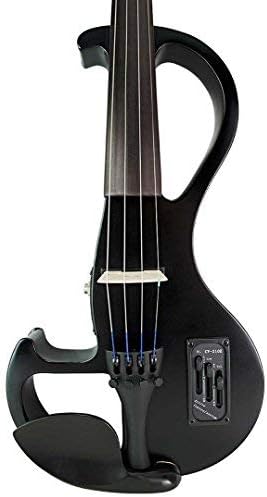
Maybe you played through middle school, or you held first chair in your high school orchestra, or you logged ten serious years before life redirected your attention. Now you want back in — and this time you’re thinking about an electric violin. An electric violin is essentially a violin body stripped down to its structural skeleton, fitted with a pickup (a sensor that converts string vibration into an electrical signal) and plugged into a headphone amp or speaker. The big appeal for returning players: you can practice at midnight through headphones without waking anyone, and you sidestep the anxiety of putting mileage on an expensive acoustic instrument while you rebuild your chops. But the market spans from $80 to well past $3,000, and the wrong choice at any budget can set your comeback back by months. This guide cuts through the noise by matching real returning-player scenarios to the instruments that actually make sense for each one.
| EDITOR'S PICKYamaha YEV104NT Electric Violin… | Mid-tierElectric Violin Bunnel NEXT (cl… | Budget pickCecilio Electric Violin 4/4 Ful… | |
|---|---|---|---|
| Size | — | 4/4 | 4/4 |
| Finish | Natural | Honey | Black metallic |
| Case | — | ✓ | — |
| Pickup | — | Piezo ceramic | — |
| Body | — | — | Solid maple |
| Fittings | — | — | Ebony |
| Price | $881.99 | $528.88 | $119.99 |
| See on Amazon → | See on Amazon → | See on Amazon → |
The Returning Player Is Not a Beginner — And the Market Doesn’t Always Respect That
This matters more than it sounds. The entry-level electric violin market — instruments like the Cecilio CEVN-1 or the Mendini MV300 — is designed and marketed almost entirely for first-time learners who have never held a bow. The setups, the included shoulder rests, the rosin quality, the bow hair tension: everything is tuned for someone who doesn’t yet know what bad feels like.
You know what bad feels like. That’s actually a liability at the budget tier, because your trained hands will immediately detect a poorly crowned fingerboard, a nut cut too high, or a bow that tracks unevenly. Reviewers with prior experience consistently report more frustration with budget electrics than first-timers do — not because the instruments are worse in absolute terms, but because experienced players notice more.
One Vangoa owner, writing an assessment that carries real weight precisely because they self-identified as a returning player (ten years of playing, five-year break), described their instrument as “great for its price” — phrasing that signals acceptance of real limitations alongside functional usability. That’s the honest frame for budget electrics and experienced hands: functional, not inspiring.
The practical takeaway: your prior training raises your floor. You should probably spend more than a true beginner would, because you’ll feel the compromises that beginners don’t.
By the numbers:
- Entry tier (Cecilio, Mendini, Vangoa): ~$80–$130
- Mid-tier stage-capable (Bridge Draco, Yamaha YEV-104): ~$400–$550
- Premium/professional (NS Design CR Series, ZETA Jazz, Wood Violins Stingray): $1,200–$3,000+
Matching Your Real Scenario to the Right Instrument
Rather than running through a generic spec comparison, let’s do what the best buying decisions actually require: map your situation honestly.
Scenario A: You’re practicing quietly at home, protecting a good acoustic
This is one of the most common returning-player use cases, and it’s also the one where buyers most frequently over-spend on acoustic tone and under-spend on playability. One Cecilio buyer described their logic clearly in aggregated reviews: they owned a gifted instrument worth around $1,000 and wanted to put practice hours on a beater electric rather than add wear to something irreplaceable. That’s sound reasoning, and it does justify a budget instrument — with one caveat.
If your goal is pure silent practice and you already own a quality acoustic, the Cecilio CEVN-1 or Mendini MV300 can serve the function. Owners across multiple review platforms consistently report acceptable intonation and playable action out of the box, particularly for scales and technical drilling where tonal nuance matters less. The tradeoff is real: these instruments will not inspire you, and the included bows in most budget packages draw consistent criticism from players with any prior technique. Budget an extra $40–$80 for a separate beginner-to-intermediate bow (a carbon fiber shaft at that price point dramatically outperforms the included wood sticks) and you’ve addressed the most common complaint.
The conservatory-trained pianist referenced in buyer review aggregations who deliberately skipped the Cecilio tier and moved straight to mid-range made a different, equally defensible call: they expected their own developed physical sensitivity to make the budget compromises unworkable. If you played at a high level before your break, that instinct is probably correct.
Scenario B: You stopped playing because acoustic violin physically hurt you
This is the use case that deserves the most careful instrument matching. Reviewers at violinist.com have flagged that chin and shoulder ergonomics are the most cited physical reasons experienced players step away — and electric violins don’t automatically solve that problem, because most full-body electrics (the kind that look like a traditional violin) use the same playing position and chinrest geometry.
One Bunnel Edge (Zebrano) buyer purchased it specifically for a spouse who had played since sixth grade and stopped because acoustic playing was causing hand pain. The Bunnel Edge drew praise in that specific context precisely because the instrument felt close enough to acoustic to feel familiar while being light enough to reduce fatigue. Published specs from the manufacturer put the Bunnel Edge at a lighter overall weight than most carved-body acoustics, and owners consistently report that the reduced resonance mass does translate to less arm fatigue over long sessions — an important distinction for players managing tendinitis, arthritis, or repetitive strain.
If physical pain is your primary reason for returning to electric, the instrument body style matters as much as the brand name. Solid-body “stick” style instruments like the NS Design CR Series take a dramatically different playing position — the instrument rests on a curved end pin or sits against the body — and several professional players and educators, as noted in Strings Magazine’s electric violin buyer coverage, recommend the NS Design ergonomic approach specifically for players managing neck and shoulder issues. That said, the CR Series starts around $1,200, so this is a meaningful investment decision, not a casual upgrade.
Scenario C: You’re rebuilding technique seriously and want an instrument that rewards real playing
This is where the Yamaha YEV-104 becomes the clear decision anchor for a mid-tier budget. The praise reviewers consistently land on — “responsive to every nuance,” “sounds like an acoustic” — is not marketing copy. It reflects something real about how the YEV’s semi-hollow body and Yamaha’s resonance chamber design transmit acoustic information back through the instrument to the player’s chin and shoulder. That physical feedback loop is what experienced players rely on to calibrate bow pressure and contact point, and it’s largely absent in solid-body budget electrics.
Sweetwater’s product overview for the YEV-104 describes the instrument’s spruce top and willow body construction in terms of acoustic resonance projection, which is unusual in the electric violin category and directly relevant for players rebuilding muscle memory. Owners who identify as returning players, specifically those with orchestral backgrounds, report that the YEV plays closer to an acoustic than any other instrument at its price range — a finding that appears consistently across MusicRadar’s coverage of the electric violin category as well.
The math here is honest: the Yamaha YEV-104 at roughly $500 costs four to six times more than a Cecilio. For a player who is genuinely committed to the comeback — not testing the waters, but planning to practice regularly and possibly perform — the YEV’s responsiveness will accelerate your retraining in ways that a budget instrument cannot. If you’re unsure whether you’ll stick with it, start lower. If you know you’re back, stretch to the Yamaha.
Scenario D: You’re a serious player who wants an electric as a primary performance tool
If you’re a professional or near-professional coming back to violin with specific performance goals — Celtic sessions, bluegrass gigs, studio session work — the conversation shifts entirely. Here the NS Design CR Series, the ZETA Jazz, and the Wood Violins Stingray enter the frame not as luxury options but as professional tools with meaningfully different tonal and pickup architectures.
The NS Design CR Series uses an internal piezo pickup (a crystal-based sensor that detects vibration mechanically) feeding into an onboard preamp with active EQ controls. The ZETA Jazz uses a magnetic pickup system with a distinctly different tonal character — warmer, with less of the piezo’s characteristic “honky” upper-midrange spike. For Celtic and traditional folk styles, the piezo tends to read as more “acoustic” on stage; for jazz and fusion, the magnetic often integrates more cleanly into a full-band mix. Per violinist.com forum discussions and Strings Magazine’s coverage of professional electric violin setups, this pickup architecture choice is the most consequential decision in the premium tier — more so than brand or body style.
One orchestral player — second-chair second violin for thirty years — documented their decision to buy a Bunnel Edge specifically for home practice without disturbing family. That’s a practical instrument choice from someone with elite technique, and it underscores a point worth naming directly: even professional players don’t always need a $2,000 instrument for every use case. Match the instrument to the job, not to your ego about your own playing level.
Frequently Asked Questions
Is a budget electric violin good enough for someone who already knows how to play? Functionally, yes — for drilling scales, intonation work, and basic practice. But experienced players consistently report more frustration with budget electrics than beginners do, because trained hands feel the compromises. If you played seriously before your break, budget an extra $40–$80 for a better bow even on a budget instrument, and recalibrate your expectations accordingly.
Will an electric violin feel the same as my acoustic under the bow? Not exactly, and this is the most important honesty to sit with before you buy. Solid-body electrics give almost no acoustic feedback through the instrument — no resonance in the chin, no body vibration under your collarbone. Semi-hollow instruments like the Yamaha YEV-104 bridge this gap meaningfully. Owners consistently report that the YEV’s resonance chamber returns enough physical feedback to feel “acoustic-adjacent” during practice.
Can I use my existing shoulder rest and chinrest on an electric violin? Usually yes, for full-body electric violins that match standard 4/4 dimensions — which covers most instruments in this guide except the NS Design CR Series and similar stick-body instruments that use a completely different support geometry. Check the instrument’s body dimensions against your existing shoulder rest’s mounting clips before assuming compatibility. Manufacturers including Yamaha publish full body dimension specs.
Is it worth spending more on a Yamaha YEV if I’m just practicing quietly at home? If “quietly at home” is your only goal and you’re genuinely uncertain whether the comeback will stick, a budget instrument is defensible. If you know you’re committed and you played at an intermediate or advanced level before your break, the Yamaha YEV’s responsiveness will actively support your retraining in ways a Cecilio cannot. The cost difference is real; so is the playing difference.
Should a returning player who already owns a good acoustic violin bother with electric at all? Yes, with a clear reason. Electric practice instruments let you log hours at any time of day or night through headphones, protect your acoustic from unnecessary wear, and — for players managing physical pain — often feel lighter and less fatiguing. If you’re returning after a long break and want to rebuild without pressure or audience, the electric is a low-stakes practice space. Once your technique is back, the acoustic is still there.
Your Decision Rule
Here’s the clean version: If you’re testing whether the comeback is real, spend $80–$130 on a budget electric and upgrade once you’ve proven to yourself you’ll practice. If you already know you’re back and you played seriously before your break, skip the budget tier — the Yamaha YEV-104 is the instrument that will actually reward your rediscovering hands. If you’re managing physical pain as a key factor, look hard at the Bunnel Edge for mid-budget ergonomic comfort, or consider the NS Design CR Series if your budget and performance goals justify the investment. And if you’re a working professional returning to add electric to a live setup, the pickup architecture decision — piezo versus magnetic — is the first question to answer, not the brand name on the headstock.
Your next step: read the full NS Design CR Series review on this site if you’re evaluating the professional tier, or check the YEV-104 buying guide if the mid-range is your ceiling. Either way, you have enough now to know which conversation you’re actually in.