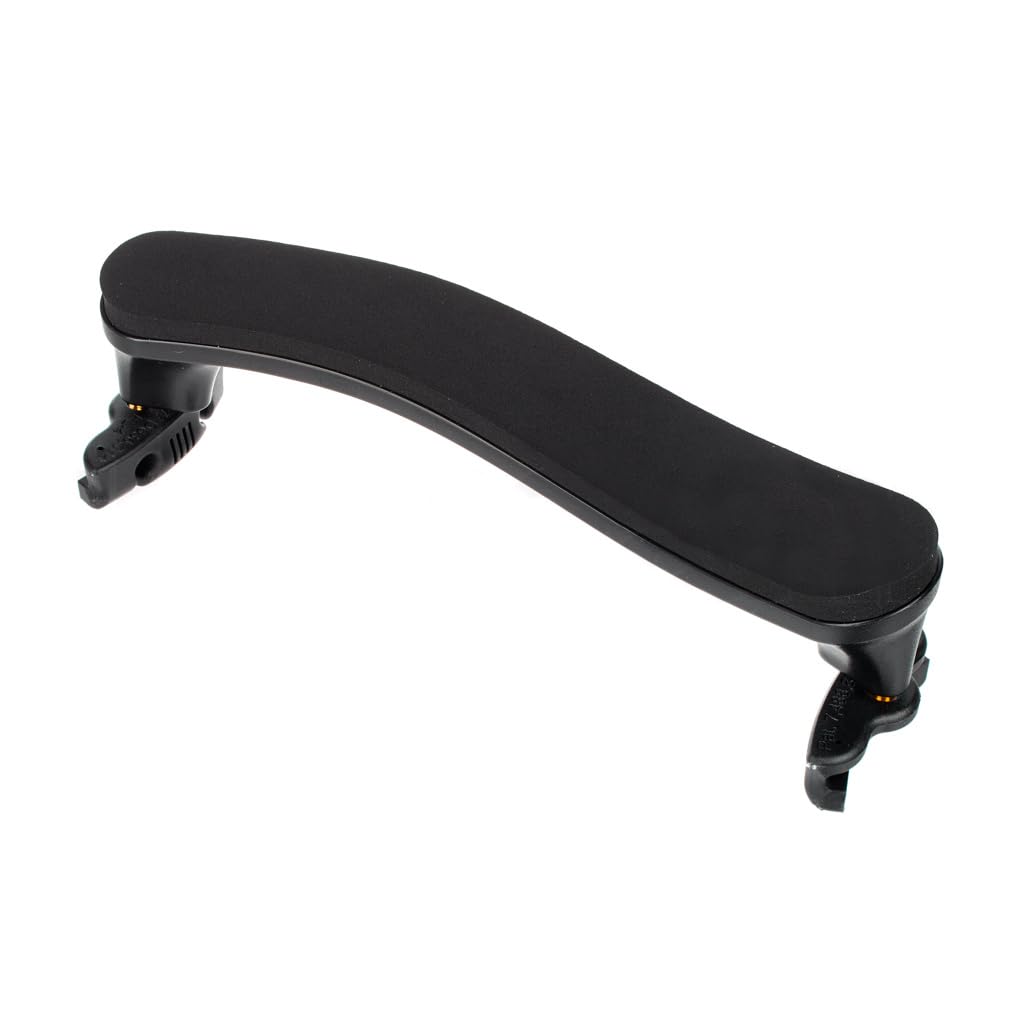
If you’ve ever watched a seven-year-old try to hold a violin in playing position — arm straining, chin jutting, the instrument sliding toward the floor — you already understand what a shoulder rest does. A shoulder rest is a curved accessory that clips onto the bottom edge of the violin’s body (the part closest to the player’s shoulder) and acts as a bridge between the instrument and the player’s collarbone and shoulder. Without one, smaller players often grip the instrument with their left hand just to keep it up, which freezes the fingers and stalls technique. With the right one, the violin stays put and the arm can move freely. The catch: “right one” depends heavily on the size of the violin, the size of the child, and how fast that child is growing. This guide covers fractional violins — sizes 1/10, 1/8, 1/4, 1/2, and 3/4 — and gives you a decision framework you can use today, whether you’re a parent buying for a beginner or a teacher advising a studio full of students.
| EDITOR'S PICKSUEWIO Violin Shoulder Rest for… | Mid-tierEVEREST Violin Shoulder Pad 1/4… | Budget pickSUEWIO Violin Shoulder Rest for… | |
|---|---|---|---|
| Fits sizes | 4/4 | 1/4-1/10 | 4/4-3/4 |
| Material | Aluminum alloy | — | — |
| Pad | Foam | — | — |
| Adjustable feet | ✓ | — | ✓ |
| Collapsible | — | — | ✓ |
| Mute included | — | — | ✓ |
| Price | $38.99 | $13.99 | $8.99 |
| See on Amazon → | See on Amazon → | See on Amazon → |
Why Sizing Is More Complicated Than It Looks
Here’s the thing most packaging doesn’t tell you clearly: violin sizing and shoulder rest sizing are not the same label system, even though they use the same fractions. A “1/2 shoulder rest” from one brand may or may not fit your 1/2 violin from another brand, because the body length — the actual measurement across the lower bout (the wider, lower half of the violin body) — varies slightly between manufacturers.
The American String Teachers Association’s sizing guidelines confirm this in their instrument measurement documentation: fit is determined by the student’s arm length and body proportion, not by age or by the fraction stamped on the instrument. That fraction is a starting point, not a guarantee.
The practical upshot for buyers: always check the body length specification on the shoulder rest packaging against the actual lower-bout width of the instrument in hand. Most manufacturers list a millimeter range. If you’re buying online without the instrument in front of you, measure the lower bout width of the violin before ordering.
By the Numbers
| Violin Size | Typical Lower Bout Width | Common Shoulder Rest Fit Range |
|---|---|---|
| 1/10 | ~195–200 mm | Listed as 1/10 or 1/10–1/8 |
| 1/8 | ~205–215 mm | Listed as 1/8 or 1/8–1/4 |
| 1/4 | ~220–235 mm | Listed as 1/4 or 1/4–1/2 |
| 1/2 | ~245–260 mm | Listed as 1/2 |
| 3/4 | ~265–285 mm | Listed as 3/4 or 3/4–4/4 |
(Measurements are approximate ranges drawn from published manufacturer specifications and luthier sizing charts; individual instruments vary.)
The Smallest Sizes: 1/10 and 1/8 Violins
This is where parents hit a wall. Fractional accessories for 1/10 and 1/8 instruments are genuinely hard to find at retail, and the selection thins out quickly outside of specialty string instrument shops and online marketplaces. A significant share of instruments sold at this size are rental instruments, and rental shops often include a basic rest — but “included” does not always mean “good enough to keep.” More on that in the FAQ below.
For tiny instruments in the 1/10–1/8 range, the Everest EZ-1A is one of the most teacher-recommended options in this tier. Violinist.com community discussions repeatedly surface this rest in the context of teacher recommendations for early-stage students on fractional instruments. The design uses a simple foam-pad foot system rather than the metal-tip clips found on larger rests; that matters because metal clips on a very small instrument can scratch delicate varnish or create uneven pressure on a thinner rib (the side wall of the violin body). Owners of the EZ-1A consistently note that installation is fast — the kind of fast you need when a six-year-old is already losing interest in the setup process.
Tradeoff to name explicitly: the EZ-1A’s height adjustment range is narrow by design. For a child with an unusually long neck or sloped shoulder, you may hit the top of the adjustment range before the fit is right. If that happens, a folded chamois cloth under the rest buys a few extra millimeters as a temporary fix, but it signals that you need a different solution — likely a custom-shaped foam rest or a consultation with the teacher about whether a sponge-style rest (a foam block attached to the instrument with a rubber band) is more appropriate for this particular child.
The 1/4 and 1/2 Sizes: The Most Commonly Purchased Range
Most students spend the most cumulative time in 1/4 and 1/2 sizes — these are the years of fastest technical development and the years when a poor setup causes the most lasting harm to posture. Strings Magazine’s accessory guide for young string players notes that poor shoulder rest fit is one of the most common root causes of left-hand tension complaints in students under age ten.
This is the tier where the Everest EZ-4A earns its reputation. Reviewers consistently flag its adjustability across sizes as its standout feature: the feet extend and contract to accommodate a range of lower-bout widths, which means it can bridge the gap between a snug 1/2 fit and a usable 3/4 fit as a child grows. At least one parent in aggregated review discussions specifically calls out a teacher recommendation for the brand before purchasing. For studios managing multiple students at different sizes, that overlap is a practical advantage.
For parents who want fast daily setup — the SUEWIO combo pack (shoulder rest plus violin mute, where a mute is a small clip-on device that softens the instrument’s volume for apartment or late-night practice) receives consistent praise for two things: its lightweight design and its reinstallation speed. Reviewers report getting the rest back onto the instrument in under thirty seconds, which is a recurring theme in parent feedback across aggregated reviews. For a household where practice happens before school, that matters more than it might seem.
The sizing-mismatch warning: the mismatch problem that plagues mute purchases — one eBoot rubber mute reviewer confirmed the product was too small for a 15-inch viola despite claiming viola compatibility — appears in shoulder rests too. Treat any rest labeled “fits 1/2–3/4” with mild skepticism until you’ve confirmed the lower-bout measurement. The fraction range on the label is the manufacturer’s tested range; your specific instrument may fall outside it.
The 3/4 Size: Transition Territory
A 3/4 violin is often where students start encountering full-size accessories that almost fit — and “almost” is the problem. A 4/4 (full-size) shoulder rest placed on a 3/4 violin will typically overhang the lower bout, rock on contact, and clip insecurely. Parents sometimes try this to avoid buying another accessory for what feels like a transitional size, but a rocking rest teaches a child to compensate with grip tension, undoing months of correct posture work.
The Strad’s guidance on posture setup for young violinists is consistent on this point: instrument fit precedes technique. A rest that doesn’t sit flush on the instrument is not a rest — it’s an obstacle.
The Kun Collapsible in its 3/4 sizing is a meaningful step up in build quality from foam-foot entry-level rests, and it introduces a student to the adjustable-metal-bar system they’ll likely use on full-size instruments for the rest of their playing life. One reviewer of the Kun Collapsible for viola documented a DIY fix — reversing a hinge arm — to achieve a tighter fit on a 16-inch instrument, which speaks to both the rest’s adjustability ceiling and the ingenuity of engaged players. Worth knowing before you buy if you’re at an edge-case size.
For parents who care about case organization, the Fiddlerman rest earns specific callouts for collapsing flat enough to fit inside the violin case without requiring a separate pouch. Parent reviewers identify this as a practical differentiator over rests that have to be removed and stored separately, which means they can get lost, broken, or simply left at home on lesson day.
If X, then Y decision rule for 3/4 buyers:
- If the student is within six months of moving to 4/4, buy a 3/4-compatible rest with a wide adjustment range (Everest EZ-4A or Kun Collapsible) so the transition doesn’t require a new purchase.
- If the student will be on 3/4 for another year or more, invest in a proper 3/4 fit and don’t rationalize a 4/4 rest as “close enough.”
Frequently Asked Questions
What size shoulder rest does a 1/4 violin need? A rest specifically labeled for 1/4 or 1/4–1/2 instruments. Measure the lower bout width of the specific violin (typically 220–235 mm for a 1/4) and match it to the rest manufacturer’s listed fit range. Don’t assume the fraction on the violin and the fraction on the rest use identical measurement standards.
Can I use a 4/4 shoulder rest on a 3/4 violin? Technically you can clip it on, but it will overhang the body, sit unevenly, and may not hold securely under playing movement. Reviewers who have tried this consistently report instability. The short answer is: don’t, unless you’re in a genuine emergency for one lesson.
At what age or skill level should a child switch to a Kun or Bonmusica rest? Age is the wrong frame — size of instrument and size of player are the right frames. The ASTA sizing guidelines focus on arm length and shoulder width, not birthdate. In practical terms, students moving to 3/4 or full-size instruments are typically ready for the Kun Collapsible or similar adjustable-bar rests. Bonmusica rests, which wrap around the shoulder and offer more ergonomic customization, are generally introduced at full-size when a student is committed enough to justify the higher investment and fitting time.
Will a violin shoulder rest fit a viola? Sometimes, with caveats. A 3/4 violin rest may fit a smaller viola body, but as the eBoot mute sizing incident illustrates, marketing claims of cross-instrument compatibility should be verified against actual lower-bout measurements. The Kun Collapsible for viola, for instance, is a distinct SKU from the violin version — that distinction exists for a reason.
How do I know if a shoulder rest is the right height for my child? With the rest attached and the violin in playing position, the child’s left hand should be able to move freely along the fingerboard without the shoulder or chin doing gripping work to hold the instrument up. Strings Magazine’s accessory guide suggests this quick check: if the instrument drops when the left hand releases, the rest is either the wrong height or the wrong fit entirely. A teacher can confirm fit in sixty seconds during a lesson.
Is the included shoulder rest on a beginner violin kit good enough to keep? Usually no. Bundled rests in entry-level kits are typically foam sponge blocks held on by a rubber band — functional for the very first weeks, but they offer no height adjustment and compress quickly. Once a student is past the first month and showing genuine interest, upgrading to a proper adjustable rest is one of the highest-value interventions a parent can make for under $20. Violinist.com forum discussions on beginner setup return to this point consistently: the bow and the rest are where kit corners get cut hardest.
Your next step: Check the lower-bout measurement of your child’s current instrument before adding any rest to your cart. If you don’t have a ruler handy, your teacher can measure it at the next lesson in under a minute — and can confirm whether your child’s neck and shoulder proportions call for a standard rest or something with more height range. That thirty-second conversation saves a return shipment.