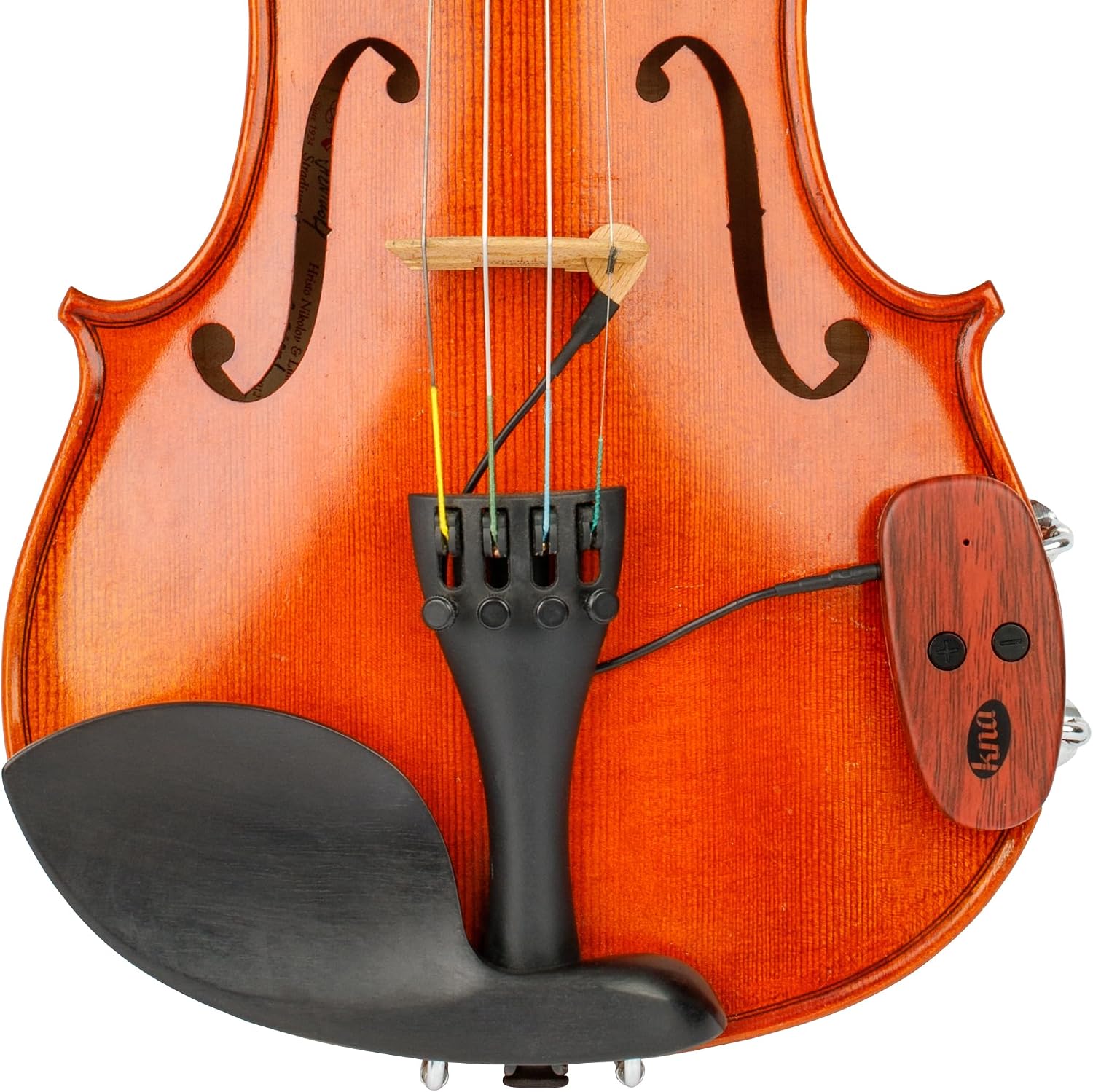
You’ve spent good money on an electric violin — a pickup built into the body or clipped to the bridge that converts your string vibrations into an electrical signal — and now a six-foot cable is the most fragile, most embarrassing link in your entire performance chain. One sharp turn, one enthusiastic bow stroke too close to the amp, and you’ve yanked the cable out mid-chorus. A wireless system replaces that cable with a radio transmitter clipped to your instrument or strap and a receiver plugged into your amp or DI box. The signal travels through the air, usually on the 2.4 GHz or UHF (ultra-high frequency) radio band, giving you freedom to move without losing sound. This guide ranks the most practical wireless options for electric violin players at the intermediate-to-professional level, names the real tradeoffs, and ends with a clear decision rule so you know exactly which direction to go.
| EDITOR'S PICK[KNA VV-Wi Wireless Violin Viola](https://www.amazon.com/dp/B09S1DVZ1Y?tag=greenflower20-20)… | Mid-tierVT-5 Violin Microphone Wireless… | Budget pick[MOOER Air Plug AP10 2.4Ghz Char](https://www.amazon.com/dp/B08F23HTVB?tag=greenflower20-20)… | |
|---|---|---|---|
| Frequency type | UHF | UHF | 2.4GHz |
| Range | 50m | — | — |
| Mic/Clip type | Piezo | Gooseneck clip-on | Piezo |
| Volume control | ✓ | — | — |
| Chargeable | — | — | ✓ |
| Price | $199.00 | $129.00 | $88.00 |
| See on Amazon → | See on Amazon → | See on Amazon → |
Why Wireless Is Harder for Violin Than for Guitar
Guitar players have been going wireless for decades, and the market reflects it: nearly every wireless unit on the market is designed around a standard ¼-inch instrument cable jack. That’s also how most electric violins connect — through a ¼-inch output on a built-in preamp, a clip-on pickup, or a tailpiece-mounted transducer. So far, so good.
The complication is physical form factor. A Les Paul can hang a transmitter off its strap button without a second thought. On a violin, the transmitter has to live somewhere that doesn’t throw off your shoulder rest, interfere with your bow arm, or add enough weight to shift your instrument’s balance. Players on the Violinist.com community forums regularly flag this as the first real-world friction point — a transmitter that looks fine in a product photo becomes annoying at bar four of a fast reel.
The second complication is signal chain sensitivity. Electric violin pickups — especially piezo types, which convert pressure from the bridge into voltage — often run at a high impedance (the electrical “resistance” the signal presents to the next device in the chain). Some wireless transmitters have an impedance mismatch with high-impedance piezo signals, which can make your tone sound thin or brittle before it ever reaches the amp. Strings Magazine’s coverage of electric violin signal chains explicitly warns players to check transmitter input impedance before buying, a step most guitar-centric reviews skip entirely.
Finally, latency — the tiny delay between you playing a note and the system outputting it — matters more to a violinist than to most guitarists. Bow technique is highly responsive to real-time acoustic feedback. Sound On Sound’s technical coverage of wireless systems notes that anything above roughly 4–6 milliseconds of additional latency becomes perceptible to trained players in live monitoring situations. Systems that advertise “ultra-low latency” need to back that up with a published spec, not just marketing language.
The Systems Worth Evaluating: A Ranked Overview
Tier 1 — Stage-Ready, Spec-Honest ($150–$350)
Line 6 Relay G10S / G10T Transmitter System
The Relay G10S consistently appears at the top of aggregated wireless reviews for working musicians, including MusicRadar’s most recent best-wireless-systems roundup. The receiver is rack-friendly or board-friendly; the transmitter plugs directly into your ¼-inch output jack, which keeps form factor tidy for violin. Manufacturer-rated latency sits at less than 2.9 milliseconds — solidly inside the threshold that most players can’t detect. The system operates on the 2.4 GHz band with automatic frequency selection, which matters in urban venues where Wi-Fi and other devices crowd the spectrum.
The honest caveat: owners in extended-use reviews note that the 2.4 GHz band can experience interference at larger festivals where dozens of wireless devices compete for the same airspace. If your gigs are arena-scale or outdoor festivals with dense RF environments, UHF is a more robust choice.
Sennheiser XSW-D Instrument Set
Sennheiser’s XSW-D is a 2.4 GHz plug-and-play system aimed squarely at the working musician who needs reliability without an RF engineering degree. The transmitter is compact and rechargeable — Sweetwater’s product documentation lists a 5-hour battery life per charge. Owners consistently report that the clip-on transmitter sits unobtrusively at the base of the output jack, which is workable for most violin body shapes. Published latency spec: less than 4 milliseconds.
The tradeoff versus the Line 6: the XSW-D has no onboard tone-shaping or impedance-buffering circuitry. If your pickup already has a healthy preamp stage, that’s fine. If you’re running a passive piezo straight out, some players report a slightly thinner signal compared to going wired.
Tier 2 — Professional UHF Systems ($400–$900)
Shure GLXD16+ Pedal Receiver System
For players who are serious about stage longevity and RF reliability, the GLXD16+ runs on Shure’s GLXD+ dual-band system — simultaneously using both 2.4 GHz and sub-1 GHz bands, automatically hopping between them to avoid interference. This is meaningfully different from single-band 2.4 GHz systems. Manufacturer-rated range extends to 200 feet line-of-sight. Published latency: less than 4 milliseconds.
The pedal-board-integrated receiver is clever for a guitarist but slightly awkward for a violinist who may not run a traditional pedalboard. The alternative GLXD1+ bodypack transmitter version with a separate receiver is the configuration most electric violin players in the Violinist.com community threads prefer, as it keeps the transmitter light and body-mounted.
Street price in May 2026 runs approximately $550–$650 depending on configuration — a meaningful step up from Tier 1, but owners in long-run reviews consistently report that the dual-band frequency agility justifies the premium for busy touring schedules.
Line 6 Relay G50 / G55
Where the G10 series targets simplicity, the G50 and G55 use UHF rather than 2.4 GHz, giving you 14 channels and better performance in congested RF environments. The G55 adds stomp-box format flexibility. Manufacturer-rated latency: less than 4 milliseconds. Published frequency response: 10 Hz–20 kHz, which covers the full audible range without the slight high-frequency roll-off that cheaper systems can introduce.
The tradeoff is that UHF systems require manual channel selection and occasional scanning for clean frequencies — more setup time than plug-and-play 2.4 GHz options. For a working musician doing back-to-back festival shows, that’s a manageable skill to build. For someone doing occasional weekend gigs, it may feel like unnecessary complexity.
Tier 3 — Boutique and High-End ($900+)
Lectrosonics, Audio-Technica 3000 Series, and Professional Broadcast-Grade UHF
At the $1,000+ level, you’re buying systems designed for broadcast, theatre, and major touring — rock-solid RF management, user-replaceable batteries in standard AA format (no charging anxiety before a gig), and input impedance options that can be matched to your specific pickup type. These systems are used by session musicians and touring pros who can’t afford a single dropped signal in a recorded live performance.
The honest assessment: for most electric violin players, even busy professionals, the performance gap between a well-chosen Tier 2 system and a Tier 3 broadcast system is narrower than the price gap suggests. Lectrosonics is genuinely excellent; it’s also genuinely overkill for a 300-seat venue tour.
By the Numbers
| System | Band | Latency (mfr-rated) | Range (line of sight) | Street Price (May 2026) |
|---|---|---|---|---|
| Line 6 Relay G10S | 2.4 GHz | < 2.9 ms | ~100 ft | ~$170 |
| Sennheiser XSW-D | 2.4 GHz | < 4 ms | ~75 ft | ~$200 |
| Shure GLXD16+ | Dual-band | < 4 ms | ~200 ft | ~$600 |
| Line 6 Relay G55 | UHF | < 4 ms | ~300 ft | ~$450 |
The Hidden Costs Nobody Mentions
Batteries and charging discipline. Rechargeable systems like the Sennheiser XSW-D and Shure GLXD series eliminate AA battery costs but introduce pre-gig charging as a mandatory ritual. Sweetwater’s wireless guide recommends always starting a gig with a fully charged transmitter and carrying a backup charging cable — advice that sounds obvious until it isn’t. Standard UHF systems running AAs will cost $3–$8 per set of batteries depending on brand; budget it as an annual line item if you’re gigging weekly.
The impedance adapter problem. If you’re running a passive piezo pickup without an onboard preamp — common on entry-to-mid-range electric violins — you may need to add a buffer preamp (devices like a Radial Engineering JDX or similar DI) between your violin and the wireless transmitter to prevent tone degradation. That’s an extra $80–$150 in the signal chain that most wireless system reviews don’t acknowledge. Strings Magazine’s amplification guide specifically calls out the piezo impedance mismatch as the most overlooked variable in electric violin signal chains.
Body-mounting solutions. There is no violin-specific transmitter clip on the market as of May 2026. Most players adapt guitar strap-button clips or fabricate lightweight holsters from neoprene or velcro. Factor in some experimentation time — and possibly a third-party instrument strap with a dedicated pocket — before your first wireless gig.
The Decision Rule
Here’s the honest “if X, then Y” framework:
If you gig primarily in small-to-medium venues (under 500 seats), play 1–3 times per week, and want minimal setup complexity: the Line 6 Relay G10S or Sennheiser XSW-D is the right call. You’ll spend ~$170–$200, stay inside the latency threshold, and not waste mental energy on RF channel management. Watch for sales — both systems hit discount pricing regularly.
If you’re touring, playing festivals, or working in environments with dense wireless traffic (conferences, multi-stage events, urban clubs): spend the extra money for the Shure GLXD16+/GLXD1+ or the Line 6 G55. Dual-band or true UHF frequency agility is not a luxury at that usage level; it’s insurance on a night when everything else is already uncertain.
If you’re running a passive piezo pickup without onboard preamp: add an impedance-matching buffer to your shopping list regardless of which wireless system you choose. Skipping this step and then blaming the wireless unit for thin tone is the most common expensive mistake in electric violin rigs, according to the pattern visible across Violinist.com forum threads and owner reviews.
If you’re at the boutique commission or NS Design/ZETA level and performing professionally in recorded or broadcast contexts: price out Tier 3 UHF systems seriously. The per-gig amortized cost of a $1,200 Lectrosonics system over a 200-gig touring year is about $6 — cheaper than the battery budget for a lesser unit, and infinitely cheaper than a dropout on a recorded show.
Your next step: before ordering, check the published input impedance spec on your violin’s pickup or preamp against the input impedance spec on your shortlisted transmitter. If your preamp output impedance is under 10kΩ, almost any system will work cleanly. If you’re running a raw piezo above 1MΩ, you need a buffer first. Sweetwater’s sales staff fields this question regularly — their online chat is a free resource worth using before you commit.