Imagine you’ve just been booked for a three-set wedding reception in a stone-walled venue and you’re standing in your practice room staring at a cable snake between your feet, wondering how you’re going to work the room without tripping over it. That cable connects your violin’s pickup — a small sensor that converts string vibration into an electrical signal — to your amp or PA system. Going wireless means replacing that cable with a tiny radio transmitter clipped to your instrument and a receiver plugged into the PA. Sounds simple. But walk into the real market and you immediately hit a fork: do you clip on a gooseneck condenser microphone (a miniature mic on a flexible arm that captures acoustic sound from the air near the bridge) or a wireless piezo transmitter (a system that sends the signal from a piezo pickup — a crystal-based contact sensor already mounted on your bridge or tailpiece — through a radio link instead of a wire)? Each approach sounds different, behaves differently on stage, and suits different players. This guide maps the decision clearly, draws on documented owner experience, and ends with a clean if/then rule so you can stop second-guessing.
| EDITOR'S PICKKNA VV-Wi Wireless Violin Viola… | Mid-tierVT-5 Violin Microphone Wireless… | Budget pickMOOER Air Plug AP10 2.4Ghz Char… | |
|---|---|---|---|
| Pickup type | UHF Piezo | UHF Gooseneck Mic | 2.4GHz Wireless |
| Volume control | ✓ | — | — |
| Range | 50m | — | — |
| Instrument fit | Violin, Viola | Violin | Guitar, Violin, Acoustic |
| Charging | — | — | Chargeable |
| Price | $199.00 | $129.00 | $88.00 |
| See on Amazon → | See on Amazon → | See on Amazon → |
The Core Decision Fork: Gooseneck Mic vs. Wireless Piezo
Before comparing specific products, understand what you’re actually choosing between.
A gooseneck condenser mic system captures the acoustic signature of your violin — room resonance, bow noise, the breath of the instrument. That natural character is its primary selling point, but it’s also its liability: condensers are omni-directional or near-omni, which means they hear the stage too. In a loud band mix or near a monitor wedge, feedback — that piercing shriek caused by the mic picking up its own amplified sound — becomes a real management problem. This is the fundamental tradeoff the gooseneck camp lives with.
A wireless piezo system bypasses the air entirely. The piezo element mounted on your bridge or saddle converts mechanical vibration directly to voltage; the wireless transmitter then broadcasts that signal to a receiver. The sound is inherently drier and more direct. You lose some of the acoustic bloom, but you gain near-total feedback immunity. Sweetwater’s piezo pickup knowledge base notes that the primary tone complaint with piezo systems isn’t wirelessly-induced — it’s the pickup loading effect, where the impedance mismatch between the piezo and the input can thin or harden the tone. A buffered preamp stage in the transmitter (or the receiver) solves most of that.
Neither approach is universally superior. Your venue size, band volume, and existing instrument setup determine which tradeoff you can live with.
UHF Gooseneck Systems: The VT-5 and XTUGA
The VT-5 is the most commonly discussed entry point for violinists trying gooseneck wireless. Owners in church worship contexts — a demanding real-world use case, because sanctuary acoustics are notoriously reflective — consistently report reliable five-hour sessions at distances under 30 feet with no meaningful interference. That’s a typical Sunday morning covered without battery anxiety. The UHF frequency band the VT-5 operates on is a meaningful advantage in dense RF environments: UHF systems generally have better penetration through physical obstructions and less crowding from consumer devices compared to the increasingly busy 2.4GHz band, a point Sound On Sound’s live wireless systems guidance has documented repeatedly.
The XTUGA system, positioned slightly up the range, draws consistent praise for sound quality from reviewers who have logged years with inferior piezo rigs first. The qualitative jump they describe tracks with what you’d expect from a properly matched condenser near the bridge: more harmonic openness. The critical complaint, however, is battery life. Multiple reviewers flag six hours as insufficient for marathon events — think festival days, marathon folk sessions, or back-to-back wedding sets with dinner service extending past midnight. If your longest gig runs six-plus hours without a solid break to swap batteries, that constraint is a real disqualifier.
Feedback reality check: Gooseneck mic users across Violinist.com forum threads consistently note that feedback management requires active EQ discipline — rolling off the low-mids where violin resonance clusters and pulling the 2–3kHz presence peak. In a quiet acoustic setting with monitors at sensible volumes, it’s manageable. In a loud Celtic session in a pub with a floor monitor two feet away, it’s a fight. Name that reality before you buy.
Wireless Piezo: KNA VV-Wi and MOOER AP10
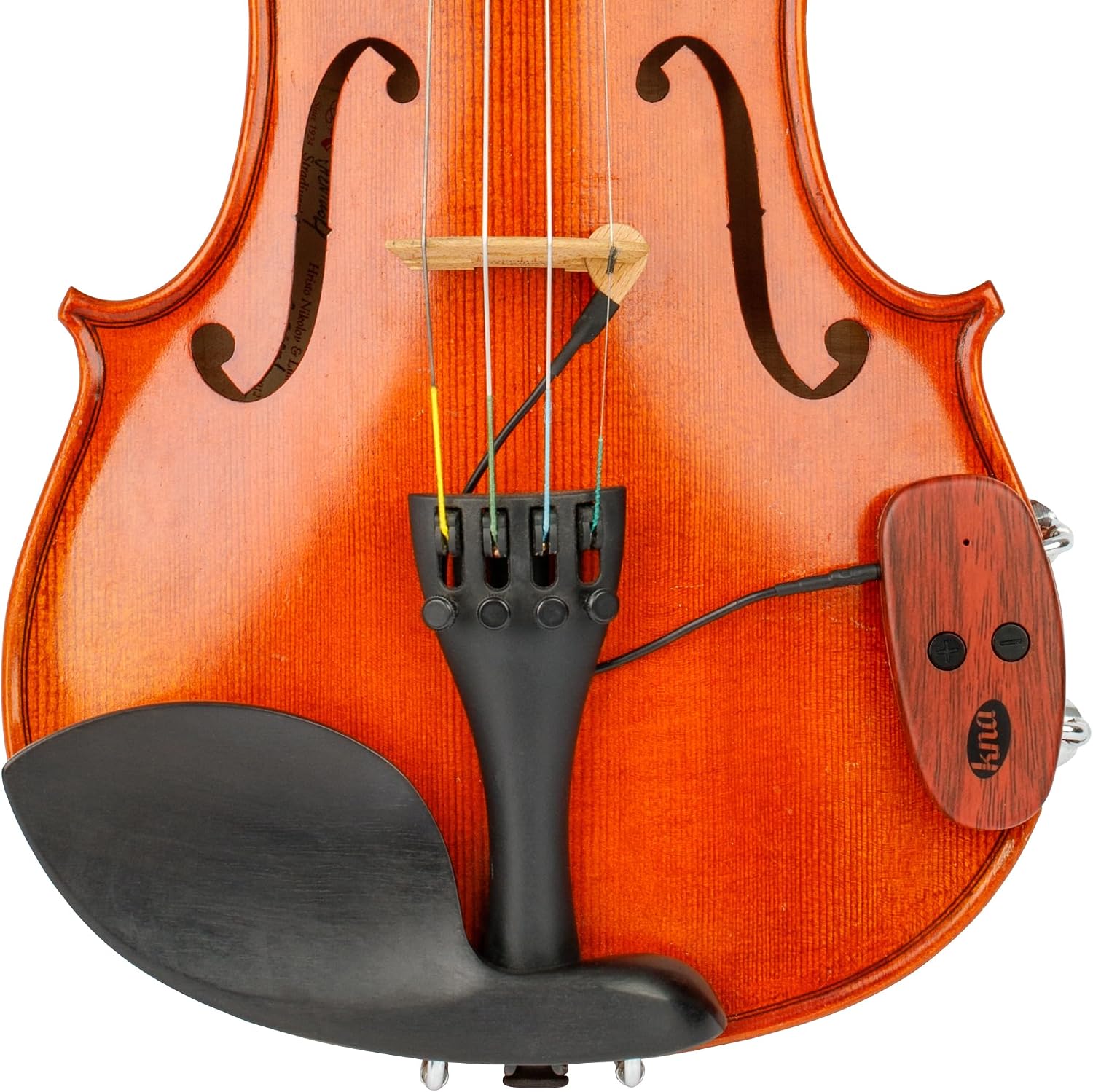
KNA VV-Wi
The KNA VV-Wi occupies a specific and well-documented niche: it’s a purpose-built wireless system designed around KNA’s own piezo pickup, and it was bought by multiple verified reviewers specifically to escape the tone-deadening effect of clamp-on pickups. One detailed owner account describes replacing a Barcus Berry 3100 clamp-on that “horribly muted” the violin — a complaint that matches what Strings Magazine’s electric violin amplification guide calls the primary failure mode of bridge-clamping designs, which can dampen the top plate’s freedom to vibrate.
Owners report that the KNA restores natural tone. The wireless range claim of 50 meters is confirmed in professional use by at least one reviewer operating in a demanding real-world environment — aboard a ship, where RF reflections off metal bulkheads would normally cause havoc. For professional folk and Celtic players who treat wireless range as a stage-survival issue, that’s meaningful confirmation.
The documented weak point: the bundled 3.5mm-to-6.3mm adapter. Multiple reviewers call it cheap and unreliable. If you own the KNA VV-Wi, budget for a quality replacement adapter immediately — this is not a hypothetical; owners report it causing connection problems in actual gigs.
MOOER AP10
The MOOER AP10 is a 2.4GHz wireless system that earns consistent praise for one specific behavioral quality: automatic pairing with no configuration. Plug in the transmitter and receiver and they find each other. For players who are not gear nerds and who don’t want to think about channel scanning before a soundcheck, this is a genuine quality-of-life advantage. Across aggregated owner reviews, the pairing experience is called “instant” and “foolproof.”
Two caveats matter. First, one reviewer reports noise in their specific signal chain — a reminder that 2.4GHz systems can interact unpredictably with other wireless devices sharing that spectrum (routers, in-ear monitoring systems). Second, battery life draws recurring minor complaints, suggesting the MOOER prioritizes simplicity over endurance. If your gig runs long, carry charged spares.
On latency: MusicRadar’s 2025 wireless systems benchmarks note that 2.4GHz systems like the MOOER typically introduce 2–6ms of audio latency, versus UHF systems that often run under 2ms. For violin, where bow timing precision matters, 5–6ms is on the edge of perceptibility for some players. In practice, reviewers don’t flag it as a dealbreaker, but players with hypersensitive timing awareness — classical crossover performers especially — should be aware.
Dual-Channel Systems: ACEMIC
The ACEMIC dual-channel system is the category outlier here, and it deserves its own framing because the use case is genuinely different.
A dual-channel wireless receiver can accept two transmitters simultaneously, which means you can mic two separate players and route them into a single PA channel — or build a single-player rig where you toggle between two mic positions for different tonal characters. One ACEMIC reviewer highlights the two-player use case explicitly: a duo performance where both players feed the same receiver without needing separate wireless channels or separate PA inputs. No other system reviewed here offers this.
The documented friction point: the gooseneck clamp. Reviewers note the clamp width is fixed with no published documentation for adjustment. If your instrument’s rib height (the depth of the violin’s sides) falls outside the clamp’s factory assumption, fitting it becomes a problem. Before purchasing the ACEMIC, measure your instrument’s rib height and contact the seller for compatibility confirmation — this is a step owners wish they’d taken first.
By the Numbers
| System | Band | Rated Range | Reported Battery | Key Limitation |
|---|---|---|---|---|
| VT-5 | UHF | ~30 ft confirmed | 5 hrs (owners) | Short range ceiling |
| XTUGA | UHF | Not spec’d by owners | 6 hrs (owners) | Marathon gig shortfall |
| KNA VV-Wi | UHF | 50m (owner confirmed) | Not flagged | Bundled adapter quality |
| MOOER AP10 | 2.4GHz | Manufacturer-rated | Minor complaints | Latency ceiling, noise risk |
| ACEMIC | UHF | Not specified | Not flagged | Fixed clamp width |
Frequently Asked Questions
How long does the battery last on the VT-5 and XTUGA during a live gig? Owners report approximately five hours for the VT-5 under real performance conditions. XTUGA reviewers report around six hours, with some flagging this as insufficient for marathon events. For any gig exceeding five hours without a guaranteed break, carry a spare battery set.
What is the usable wireless range of the KNA VV-Wi in a real performance space? Owners confirm 50 meters in daily professional use, including environments with significant RF reflections. For most stage-to-FOB or stage-to-monitor-desk runs, this is ample headroom.
Can I use the dual-channel ACEMIC system to mic two violinists into the same receiver simultaneously? Yes — this is the system’s explicit differentiator and confirmed by reviewer accounts. Both transmitters route to the single receiver, making it the only system in this guide designed natively for two-player use.
Does a wireless gooseneck mic system produce more feedback than a cabled piezo pickup on stage? Yes, meaningfully so. A condenser gooseneck mic captures ambient stage sound and can excite feedback loops from monitor wedges. A piezo system — wired or wireless — is essentially feedback-immune because it responds only to bridge vibration. Players in loud or monitor-heavy stage setups should factor this in.
Will the MOOER AP10 work with any violin that has a piezo pickup output? The MOOER AP10 accepts a standard 3.5mm input from the transmitter side, so it’s compatible with any violin that has an output jack you can connect to via the appropriate cable. It is not instrument-specific. However, if your violin’s onboard piezo is passive and unbuffered, you may notice impedance-related tone coloration — the same issue that affects any passive piezo through a low-impedance input.
Is there noticeable audio latency with 2.4GHz systems like the MOOER compared to UHF systems? Published benchmarks from MusicRadar’s 2025 wireless systems coverage put 2.4GHz latency generally in the 2–6ms range, with UHF systems often under 2ms. Most players won’t perceive this in a live mix. Players with very high timing sensitivity — particularly classical or crossover performers bowing at slow tempos — may notice it. UHF is the lower-latency choice if this matters to you.
The Decision Rule
Here’s the clean if/then framework based on everything above:
-
If you play in quiet-to-moderate environments (worship, acoustic sessions, small venues) and value acoustic tone fidelity → Start with a UHF gooseneck system like the VT-5; upgrade to XTUGA if you need better sound quality and your gig reliably ends before hour six.
-
If you play loud stages, use floor monitors, or need feedback immunity → Go piezo wireless. The KNA VV-Wi is the well-documented choice; replace the adapter immediately.
-
If you want zero-configuration setup and play gigs under five hours in manageable RF environments → The MOOER AP10’s automatic pairing makes it the lowest-friction entry into piezo wireless.
-
If you perform as a duo or want the flexibility to cover two players from one wireless system → The ACEMIC dual-channel is the only system here built for that use case. Measure your rib height before ordering.
Your next step: identify your longest gig and your loudest stage environment. Those two variables eliminate more options than any spec sheet. Once you know your floor, the right system becomes obvious — then read the pairing guide for your amp or PA input to make sure your impedance chain is clean from pickup to speaker.