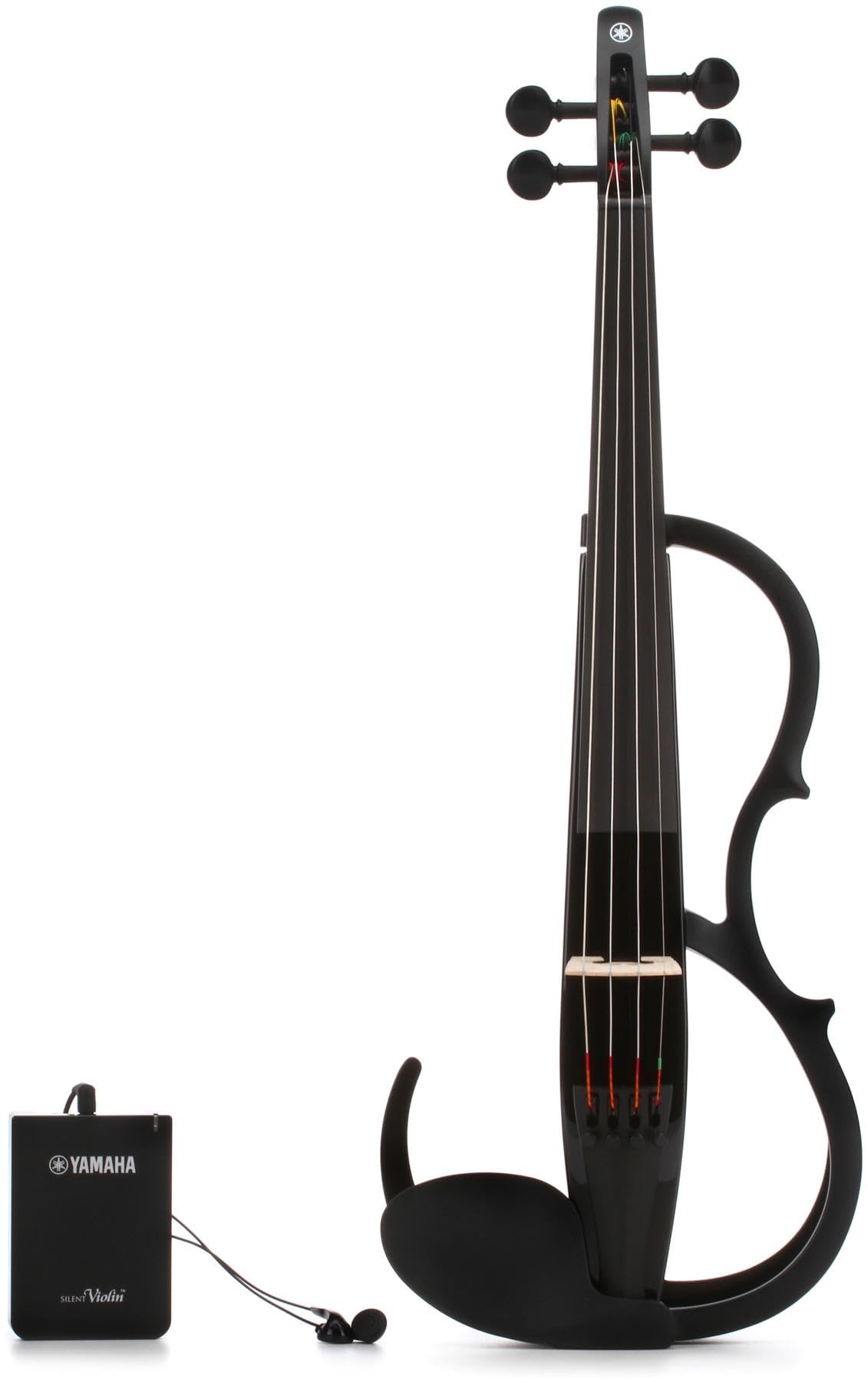
You’ve hit a wall with your neighbors, your apartment lease, or your touring schedule — and someone told you a “silent violin” is the solution. A silent violin (also called a practice violin or acoustic-electric silent instrument) is exactly what it sounds like: a stripped-down instrument with no resonant body cavity, so it produces almost no audible acoustic sound. You plug headphones directly into a small built-in preamp (the electronics unit that boosts and shapes the signal), practice at full intensity, and the neighbors never know. The Yamaha YSV104 is one of the most visible instruments in this category, retailing around $1,100 in mid-2026. That’s real money — not a casual purchase. This article breaks down exactly what that $1,100 buys you, what it doesn’t, and whether you’re better off spending more, spending less, or spending differently.
| EDITOR'S PICKYamaha Silent Series SV-250 Ele… | Mid-tierYamaha YEV105NT Electric Violin | Budget pickYamaha YEV104NT Electric Violin… | |
|---|---|---|---|
| Strings | — | 5 | 4 |
| Finish | Shaded Brown | Natural | Natural |
| Body Shape | Silent Series | YEV | YEV |
| Price | $2,149.99 | $959.99 | $881.99 |
| See on Amazon → | See on Amazon → | See on Amazon → |
What the YSV104 Actually Is (and Isn’t)
Let’s start with an honest frame: the YSV104 is primarily a practice tool, not a performance instrument. That isn’t a knock — it’s the most important thing to understand before you evaluate the price. Yamaha designed the Silent Series specifically around the practice use case: late-night woodshedding, apartment living, silent warm-up backstage. The instrument’s entire architecture reflects that priority.
The body is a minimalist frame — a thin resonance chamber that Yamaha calls a “resonance body,” which is shaped roughly like a traditional violin outline but hollow only in a very limited sense. It does produce marginally more acoustic resonance than a fully solid-body electric violin, which Yamaha claims gives the bowing feel a slightly more natural response under the bow. Published spec sheets list the body as spruce top with maple back and sides — the same tonewoods you’d find on an acoustic instrument — but the cavity is so small that its acoustic output is genuinely whisper-quiet in a room.
The onboard preamp is where much of the value lives. The YSV104 ships with a three-band EQ (low, mid, high frequency controls), a built-in reverb (the electronic effect that simulates playing in a larger acoustic space, making headphone practice feel less sterile), and a stereo aux input so you can pipe in a backing track. Sweetwater’s product listing highlights the aux input as a primary selling feature, and owners on violinist.com forums consistently name it as the detail that makes daily practice sessions actually enjoyable.
The output side gives you both a headphone jack and a standard quarter-inch output jack — meaning you can also plug into an amplifier or a DI box (a direct input box that converts your instrument signal to a format a PA or recording interface can accept) for live use. This dual-output design is what lets Yamaha market the YSV104 as “stage capable,” and it’s technically true. But that’s the first place where you need to pump the brakes.
The Tradeoff You Need to Name Before You Buy
Here’s the honest tension at $1,100: you’re paying a premium for the practice features, not for the performance features. The built-in preamp that makes headphone practice great is exactly what limits the instrument’s ceiling as a stage tool.
The onboard EQ is designed for headphone monitoring, not FOH (front-of-house — the main speaker system in a venue) performance. Owners who have run the YSV104 through a PA consistently report that the tone sits in an awkward middle ground: warmer and rounder than a fully solid-body instrument like a ZETA or NS Design, but without the clarity or projection control a working stage musician needs to cut through a loud band. Sound On Sound’s analysis of silent instruments in the practice-vs-performance category notes this pattern across the segment — instruments engineered for headphone response tend to require additional outboard EQ to perform well live.
That’s not catastrophic — plenty of touring players add a preamp pedal or a parametric EQ to the chain — but it means the $1,100 instrument isn’t actually a complete stage solution. Budget an additional $100–$300 for outboard signal shaping if stage use is your real goal, and suddenly you’re at a price point where the NS Design CR4 Radius (starting around $1,200–$1,500 as of mid-2026) becomes a legitimate alternative comparison.
By the numbers:
| Use case | YSV104 fit | What you might need to add |
|---|---|---|
| Silent apartment practice | Excellent | Nothing |
| Backstage silent warm-up | Excellent | Nothing |
| Stage performance (main instrument) | Moderate | Outboard preamp/EQ, ~$100–$300 |
| Studio recording (direct in) | Good | May need DI or interface preamp |
Where the $1,100 Is Genuinely Well Spent
Pull back from the stage limitation for a moment, because the YSV104 does several things at this price point that genuinely justify the number.
Build quality is real. Yamaha’s manufacturing consistency is well-documented across instrument categories. MusicRadar’s 2025 electric violin roundup notes the YSV104 as a benchmark for fit-and-finish in its price tier — the neck heel joint is solid, the tuning machines hold well under temperature changes, and the finish is uniform. Owners on violinist.com who’ve owned the instrument for two or more years rarely surface structural complaints; the reliability discourse is mostly absent, which is meaningful in a segment where cheaper instruments generate constant forum threads about seam separations and neck resets.
The headphone experience is genuinely premium. At $1,100, the built-in reverb and three-band EQ are tuned well enough that long practice sessions feel musical rather than clinical. This matters more than it sounds. Intermediate players who find headphone practice sessions unpleasant will practice less — it’s that simple. The aux input integration (plug your phone in, play along with a recording) is implemented cleanly without the ground hum problems that plague cheaper aux-in implementations. Strings Magazine’s buyer’s guide identifies seamless aux integration as a differentiating feature in the silent violin category, and the YSV104 scores well here.
Resale value holds. As of mid-2026 Reverb pricing, used YSV104 units in good condition are selling in the $650–$800 range consistently. For a musician who might hold the instrument two to three years before upgrading, that’s a reasonable depreciation curve compared to cheaper instruments that bottom out at $150–$200 used.
Who Should Buy It, and Who Shouldn’t
This is where the decision framework gets concrete. The YSV104 at $1,100 is the right call under a specific set of conditions — and the wrong call under others.
Buy the YSV104 if:
- Silent practice in a shared living space is your primary need, and you log serious daily hours. The practice ergonomics and headphone system are the best in class at this price.
- You already own a separate stage instrument and want a dedicated warm-up / practice violin that matches the playability of your performance gear without risking your main instrument in transit.
- You’re an advancing intermediate player whose current practice instrument is a sub-$300 silent violin and you’re noticing tonal and ergonomic limitations. The jump to YSV104 will feel significant.
Don’t buy the YSV104 if:
- Your primary goal is a single instrument that covers both stage performance and silent practice. The instrument can do both, but it’s compromised on stage — and at $1,100, you’re not getting the performance headroom you’re paying for.
- You’re a professional folk, Celtic, or bluegrass player whose electric violin is your primary income instrument. At this price, you need a purpose-built performance instrument first. Consider the Bridge Draco or the NS Design CR Series, and solve the practice problem separately with a $200–$300 entry-level silent instrument.
- You’re comparing this to a standard electric violin (a full solid-body instrument primarily designed for stage and recording use) and hoping the YSV104 doubles as one. It doesn’t, not convincingly.
The Alternatives Worth Naming Honestly
Before you commit, here are the comparison points that actually matter at this price tier.
The Yamaha YEV-104 (~$500) is Yamaha’s performance-first electric violin. It has no built-in headphone preamp, so it’s useless for silent practice, but its stage tone is significantly more refined than the YSV104’s. If performance is the priority, this is the better Yamaha to buy, and you bank $600 in savings.
The NS Design CR4 Radius (~$1,200–$1,500) is the instrument that the YSV104 is most often cross-shopped against among intermediate-to-advancing players. It has no built-in headphone preamp, but its pickup system (a combination piezo-magnetic blend that NS Design calls the “Polar” pickup) is widely regarded among owners as substantially more stage-ready. Per violinist.com community discussions, players who bought the NS Design after considering the YSV104 consistently cite the pickup quality and ergonomic neck heel as the deciding factors.
The dedicated silent instrument + separate stage instrument split — buying a $200–$300 Cecilio or Mendini for silent practice and investing $800+ in a stage-focused instrument — often delivers better outcomes for players whose use cases are clearly separated. The YSV104’s value proposition weakens when you model it this way.
The Honest Verdict
The Yamaha YSV104 at $1,100 is worth the money for one specific buyer: the serious intermediate player who practices daily in a noise-sensitive environment and wants practice-session quality that doesn’t make the hours feel like a punishment. Yamaha has engineered something genuinely good here in that narrow use case. The build quality is real, the depreciation is manageable, and the headphone system is best-in-class for the price.
It is not worth the money as a primary performance instrument, not worth the money if you’re a working professional evaluating a single-instrument solution, and not worth the money if you can clearly separate your practice and performance needs and solve them independently for less.
The decision rule: If silent practice is 70% or more of your use case, buy the YSV104. If stage performance is 50% or more of your use case, redirect that $1,100 toward a purpose-built electric violin and solve the practice problem separately.
Your next step: If you’re landing in the “stage performance matters” camp, our deep-dive comparison of the NS Design CR Series against the Bridge Draco lays out exactly how their pickup systems, neck profiles, and real-world owner reliability compare — read that before you commit at this price point.